
A group of progressive Belgian artists, having …
Years: 1883 - 1883
October
A group of progressive Belgian artists, having been brought together by a common interest in Symbolist painting, establish the the revolutionary art society of Les Vingt (”the Twenty”) at Brussels on October 28, 1883.
Like their French and German contemporaries, these painters, who are centered on Brussels, have begun to shift the emphasis in their works from the world of daily life outside the artist, which the Impressionists have captured, to the inner life, a world that celebrates mystery, allusion, and symbol.
Belgian Symbolist painting employs simplified forms, heavy outlines, a subjective use of color, and a heightened spiritual content inspired by religious, exotic, and primitive cultures.
These techniques are demonstrated in the paintings and graphics of James Ensor, Jan Toorop, and Henry van de Velde, all members of Les Vingt.
Ensor, an acknowledged master by the time he was twenty years old in 1880, had pursued a youthful infatuation with the art of Rembrandt and Rubens and then adopted the vivacious brushstroke of the French Impressionists.
When Ensor's works are rejected by the Brussels Salon in 1883, he joins Les Vingt.
While Ensor's early works, such as Russian Music (1881) and The Drunkards (1883), depict realistic scenes in a somber style, his palette subsequently brightens and he favors increasingly bizarre subject matter.
Such paintings as The Scandalized Masks (1883; Musée Royal des Beaux-Arts de Belgique, Brussels) feature figures in grotesque masks inspired by the ones sold in his mother's gift shop for Ostend's annual Carnival.
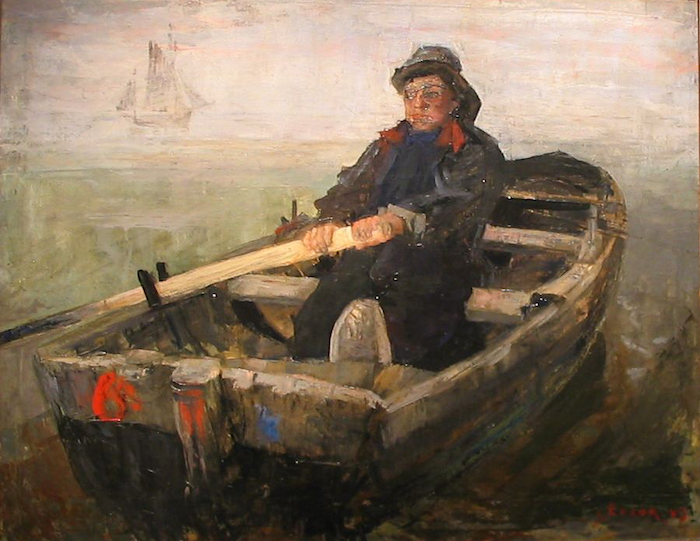
James Ensor: The Rower (1883) KMSKA (Royal Gallery), Antwerp. Photo taken by Stagehand)
Locations
People
Groups
Topics
Subjects
Regions
Subregions
Related Events
Showing 10 events out of 11215 total
Years: 1883 - 1883
October
James Ensor: The Rower (1883) KMSKA (Royal Gallery), Antwerp. Photo taken by Stagehand)
Locations
People
Groups
Topics
Subjects
Regions
Subregions