
A Genoese black powder rocket sets a …
Years: 1379 - 1379
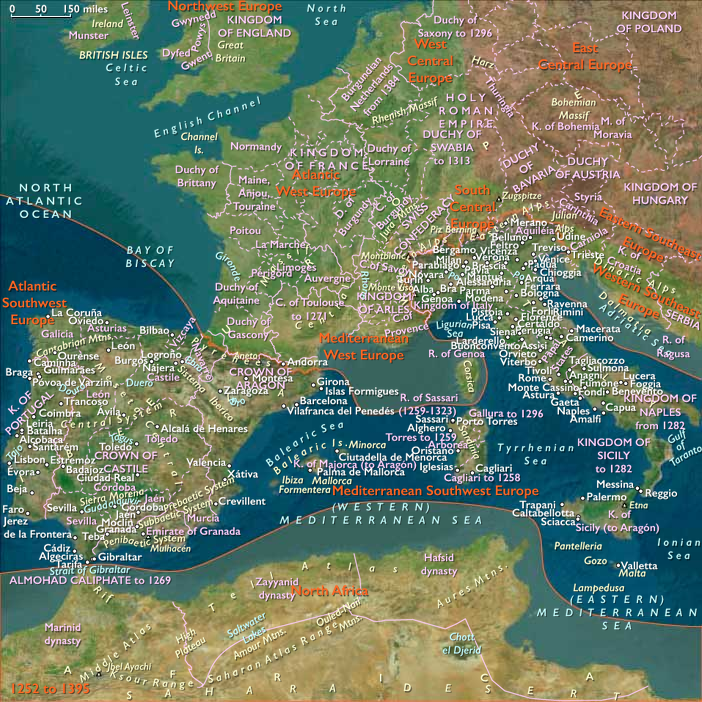
A Genoese black powder rocket sets a defending tower ablaze in late 1379 during the siege of Chioggia, thereby eliminating the last pocket of resistance and enabling the city’s capture.
Locations
Groups
Topics
Commodoties
Subjects
Regions
Subregions
Related Events
Filter results
Showing 10 events out of 43703 total
Graz, situated on the Mur River at the foot of the Styrian Alps, has become the principal city of Styria; the Leopoldine Habsburgs make it their seat in 1379.
The city’s name is derived from the fortress that is located on top of the Schlossberg (1,558 feet/475 meters high), a defensive site since ancient times.
It is Emperor John's turn, in 1379, to escape prison—with Venetian and Turkish aid—and be restored to the throne, on the condition that he recognize Andronikos as his rightful heir and swear allegiance as the vassal of Murad, who compels John to pay tribute and lend him military aid.
James of Baux, who is the son of Francis of Baux by Margaret of Taranto (circa 1325–1380), daughter of Prince Philip I of Taranto and his second wife, Catherine of Valois.
Margaret is thus sister of Robert of Taranto and Philip II of Taranto, both of whom had reigned as princes of Achaea and titular emperors of Constantinople (Robert II and Philip III).
On the death of the childless Philip II of Taranto in 1373, most of the barons in the principality of Achaea had recognized as his heir Queen Joanna I of Naples.
When in 1376 or 1377 she leased the territory to the Knights Hospitaller for five years at four thousands ducats a year, Philip II's relatives had put forward a rival candidate in James of Baux.
The Navarrese Company, after leaving the service of the Knights Hospitallers, the military-monastic order of Rhodes, takes up with this the latest claimant to Achaea.
Indeed, the Gascon Mahiot de Coquerel and the Navarrese govern the entire Morea under the auspices of James.
The Catalan Grand Company, under the protection of the the late Aragonese king Frederick of Sicily, has dominated the region of central Greece.
This changes in 1379, when Urtubia with a large force invades Boeotia and sacks Thebes with the assistance of the archbishop of the city, Simon Atumano.
At this point, the Navarrese Company takes on a different character.
Some men who had served under Urtubia …
…are with Mahiot in the Morea again.
The Company organizes itself as a viceregal power in Achaea under three captains: Mahiot, Pedro Bordo de San Superano, and Berard de Varvassa.
Henry II of Castile and León has for most of his reign had to fight off the attempts of John of Gaunt, a son of Edward III of England, to claim the Castilian throne in right of his second wife, Pedro's daughter.
At his death on May 29, 1379 at Santo Domingo de la Calzada, his twenty-one-year-old son by his wife Juana Manuel of Castile, daughter of Juan Manuel, Duke of Penafiel, head of a younger branch of the royal house of Castile, succeeds him as John I.
The Verge Escapement and the Advancement of Mechanical Clocks (1379)
The first major breakthrough in mechanical clock construction came with the European discovery of the verge escapement mechanism, a system that regulated the speed of a falling weight, allowing for greater accuracy in timekeeping.
The verge escapement works by:
- Using an oscillating horizontal bar (foliot) attached to a vertical spindle (verge).
- The verge has two protrusions (pallets) that engage with the teeth of a gear driven by the weight.
- As one pallet meshes with a gear tooth, it momentarily stops the wheel from turning, thereby regulating the descent of the weight.
The First Known Example: The Ornate Clock of Rouen (1379)
- The earliest surviving example of this mechanism appears in an ornate clock built in Rouen in 1379.
- This clock represents one of the first uses of verge escapement in a large-scale public timepiece, marking a milestone in medieval horology.
Impact and Significance
- The verge escapement was a crucial step toward modern mechanical clocks, enabling:
- More consistent and reliable timekeeping.
- The development of public clocks in European cities.
- The eventual transition from water clocks and sundials to fully mechanical timepieces.
- This innovation paved the way for advancements in clock design, leading to pendulum clocks in the 17th century, which further improved accuracy.
The 1379 Rouen clock stands as a landmark in medieval clockmaking, demonstrating the growing sophistication of European timekeeping technology and its lasting influence on modern horology.
The presence of Master Bertram, a native of Minden in Westphalia, is recorded in Hamburg from 1367, by which time he is apparently the city’s leading painter and where Bertram executes a sculpturesque altarpiece, bearing the date 1379, for Saint Peter’s Church, in which it will be erected in 1383.
The complex theological program of the altarpiece’s twenty-four naturalistically painted panels depict, in turn, the Creation; the story of Adam and Eve; Cain and Abel; Abraham, Isaac, and Jacob; the Nativity; and the Infancy of Christ.
Master Bertram, a precursor of the realistic Flemish approach of the fifteenth century, and also of the 'soft style', may have some contact with Theodoric of Prague and with French art.
The Venetians had attempted to attack Traù again in spring 1379 but were repelled.
Vettor Pisani during the previous summer had been employed partly in attacking Genoa in Cyprus, but mainly in taking possession of the Istrian and Dalmatian towns that support the Hungarians from fear of the aggressive ambition of Venice.
He had been ordered to winter on the coast of Istria, where his crews suffered from exposure and disease.
Genoa, having recovered from the panic caused by the disaster at Anzio, decides to attack Venice at home while the best of her ships are absent with Carlo Zeno. The Ligurian republic sends a strong fleet into the Adriatic under Luciano Doria.
Pisani had been reinforced early in the spring of 1379, but when he is sighted by the Genoese fleet of twenty-five sail off Pola in Istria on May 7, he is slightly outnumbered, and his crews are still weak.
The Venetian admiral would prefer to avoid battle, and to check an attack on Venice itself, by threatening the Genoese fleet from his base on the Istrian coast.
He is forced into battle by the commissioner (proveditore) Michele Steno, who as agent of the senate has authority over the admiral.
The Venetians are defeated with the loss of all their galleys except six.
Luciano Doria falls in the battle, and the Genoese, who have suffered severely, do not at once follow up their success.
Pola has been nearly demolished by the Genoese in the course of the naval actions.
The late Novgorodian Prince Alexander Nevsky is canonized locally in Vladimir in 1380.
