A Frenchman named Jacques Duese, after his …
Years: 1316 - 1316
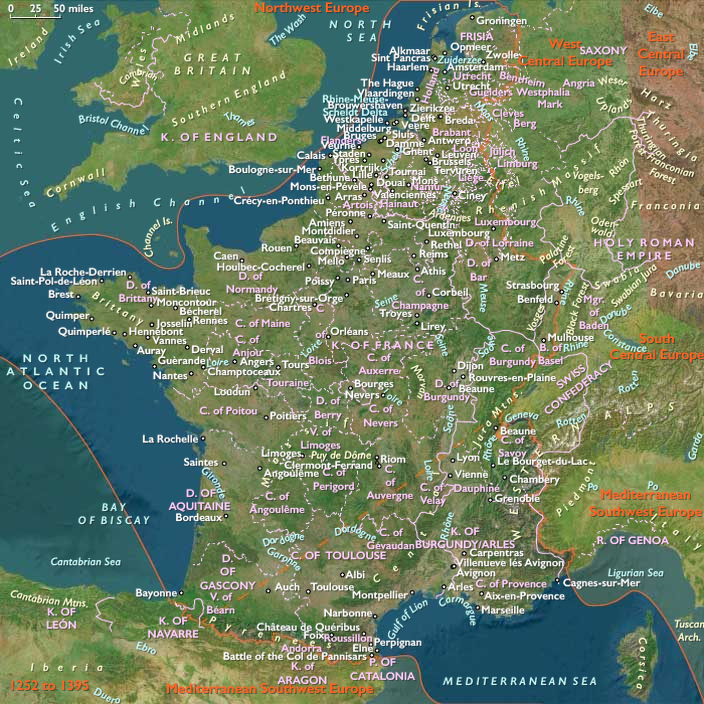
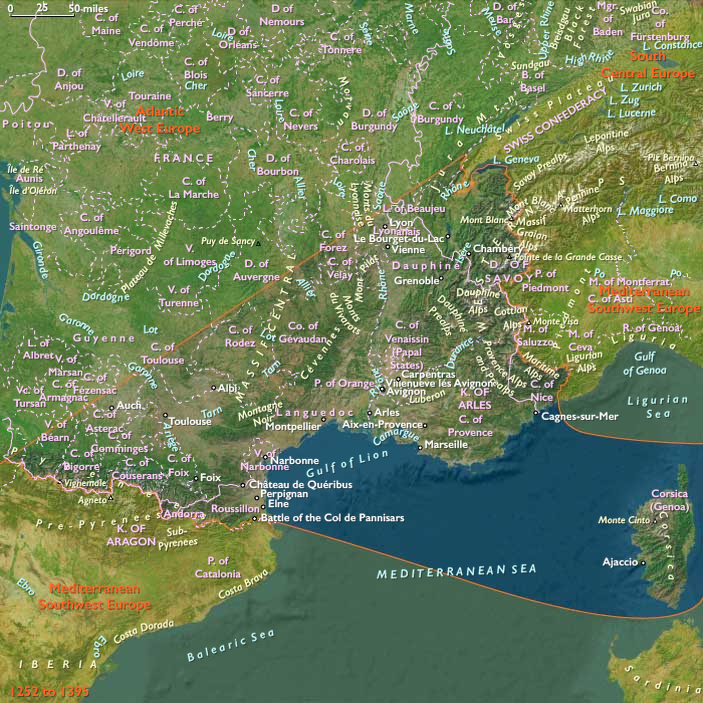
A Frenchman named Jacques Duese, after his election in 1316, becomes Pope John XXII and establishes the papal residence at Avignon.
Locations
People
Groups
Topics
Subjects
Regions
Subregions
Related Events
Filter results
Showing 10 events out of 44766 total
Ramon Llull mounts a philosophic defense of Christianity against the teachings of Averroes in his principal work, Ars magna (“The Great Art”).
The Catalan poet, philosopher, and Christian mystic dies in Mallorca 1316, leaving almost three hundred works in Latin and Catalan.
John III of Brabant’s Marriage and the Breakdown of Franco-Brabant Relations (1311–1316)
As part of a gesture of rapprochement with France, Duke John III of Brabant married Marie d'Évreux (1303–1335) in 1311. Marie was the daughter of Count Louis d'Évreux and Margaret of Artois, making her the niece of King Philip IV of France. This dynastic alliance was meant to strengthen ties between Brabant and France, but tensions quickly emerged.
French Demands and Brabant’s Refusal (1316)
- In 1316, the new French king, Louis X, sought to use Brabant as an ally against Flanders, a long-standing rival of the French Crown.
- He demanded that Brabant cut off trade with Flanders and participate in a French military campaign against the rebellious Flemish.
- However, the Brabantine councilors, representing the duchy’s powerful merchant towns, found this demand impossible to fulfill, as Brabant was economically dependent on trade with Flanders, particularly its textile and commercial networks.
Louis X’s Retaliation and Violation of Treaty Terms
- In reprisal for Brabant’s refusal, Louis X prohibited all French trade with Brabant in February 1316, dealing a major economic blow to the duchy.
- This move violated a treaty of friendship that Louis had personally signed with Brabant in October 1315, further souring relations.
- The embargo highlighted the growing conflict between Brabant’s economic interests and French royal ambitions, demonstrating that marital alliances alone could not override economic realities.
Impact and Legacy
- The failed alignment pushed Brabant toward a more neutral or anti-French stance, as it needed to maintain commercial independence from France.
- The duchy increasingly positioned itself as a key player in the Low Countries, balancing between the competing influences of France, the Holy Roman Empire, and Flanders.
- The conflict foreshadowed Brabant’s later role in resisting French centralization efforts while continuing to profit from its powerful mercantile economy.
John III’s marriage alliance with France (1311), though politically strategic, failed to secure long-term Franco-Brabant relations, as economic priorities ultimately overrode dynastic ties.
Edward Bruce, brother of Robert, had in 1315 invaded Ireland with six thousand men in pursuit of some hereditary claim to the earldom of Ulster.
After routing the earl’s forces near Connor and gaining the allegiance of the inhabitants of Connaught and West Meath, Edward is crowned High King in 1316.
Many Anglo-Irish support him, increasing his power base.
As a consequence, the Bishop of Nitra excommunicates him and his followers once again.
The city of Lublin, located about one hundred miles (one hundred and sixty kilometers) southeast of Warsaw and founded in the late ninth century, grows around a twelfth-century castle and is chartered in 1317.
Martini paints a panel, Saint Louis of Toulouse Crowning Robert of Anjou King of Naples, in 1317.
Like his earliest dated work, the colossal Maesta, the Neapolitan panel is characterized by complex and rhythmic linear patterns, sumptuous, glowing color, and the lavish use of gold.
Robert of Clermont and the Foundation of the Bourbon Dynasty (c. 1272–1317)
Robert of Clermont, the sixth son of King Louis IX of France (Saint Louis) and Margaret of Provence, played a pivotal role in establishing the House of Bourbon, which would later become one of the most powerful dynasties in French history.
Marriage and the Bourbon Inheritance
- Around 1272, Robert married Beatrice of Burgundy, the heiress to the Seigneury of Bourbon.
- Through this marriage, he secured the Bourbon lands, laying the foundation for the House of Bourbon.
- Although Bourbon was initially a lordship, it was later elevated to a duchy in 1327, under Robert's son, Louis I, Duke of Bourbon.
Robert of Clermont’s Role in French Politics
- Despite being a prince of royal blood, Robert’s role in French politics was relatively limited, as he was not expected to inherit the throne.
- He was injured at the Battle of Furnes (1297), which left him with mental impairments, preventing him from taking an active role in government.
The Bourbon Dynasty’s Future
- Robert died in 1317, but the House of Bourbon continued through his son, Louis I, who would become the first Duke of Bourbon in 1327.
- The Bourbon dynasty gained increasing prominence over the next two centuries, culminating in the accession of Henry IV in 1589, making the Bourbons the ruling house of France until the French Revolution.
Robert of Clermont’s marriage to Beatrice of Burgundy ensured the rise of the Bourbon dynasty, which would eventually produce some of the most influential monarchs in European history.
The Succession Crisis of 1316–1317 and the Origins of the Salic Law Interpretation
Upon the death of Louis X of France in 1316, his only son, John I, posthumously born on November 15, 1316, became king. However, John lived only a few days, dying on November 19, 1316. His eldest uncle, Philip of Poitiers, had been acting as regent but now saw an opportunity to claim the throne for himself.
Philip V’s Claim and the Exclusion of Joan
- John I’s death created uncertainty, as Louis X had also left behind a daughter, Joan (born in 1312), who by traditional inheritance laws should have succeeded him.
- However, Philip of Poitiers, Louis X’s twenty-three-year-old younger brother, disregarded Joan’s claim, arguing that a woman could not inherit the throne.
- To legitimize his claim, Philip convened an assembly of prominent citizens in 1317, which declared that a woman could not succeed as ruler of France.
- He was crowned Philip V in January 1317, solidifying his rule.
The Establishment of the Male-Only Succession Rule
- Although no formal "Salic Law" (excluding female succession) was yet established, Philip V’s succession set a powerful precedent that later French kings and legal scholars would invoke.
- This principle would be fully codified in the 15th century, but its origins trace back to this 1316–1317 succession crisis.
- The exclusion of Joan of Navarre from the French throne had long-term consequences, particularly in the Hundred Years' War (1337–1453), when England’s Edward III used his maternal descent from Philip IV to justify his claim to the French crown.
Navarre’s Separation from France
- While Philip V successfully secured the French throne, Joan’s exclusion from France's succession did not go unchallenged elsewhere.
- In Navarre, where inheritance laws did allow female succession, Joan’s claim was later recognized, and she became Queen Joan II of Navarre in 1328, effectively separating Navarre from France after nearly thirty years of union.
Legacy
- The events of 1316–1317 shaped the future of French succession law, ensuring that only male heirs could inherit the throne, a rule that remained in force until the end of the monarchy.
- Philip V’s strategic maneuvering prevented the Capetian line from passing through a female heir, securing his family's continuity in power.
- The exclusion of female heirs later became a key point of contention in European dynastic disputes, influencing both internal French politics and international conflicts.
Philip V’s assumption of the throne in 1317 not only determined the immediate succession crisis but also set the foundation for centuries of male-only inheritance in France, ultimately influencing the course of European history.