
Ragnar’s Viking Invasion of the Seine and …
Years: 845 - 845
March
Ragnar’s Viking Invasion of the Seine and the Sack of Paris (845)
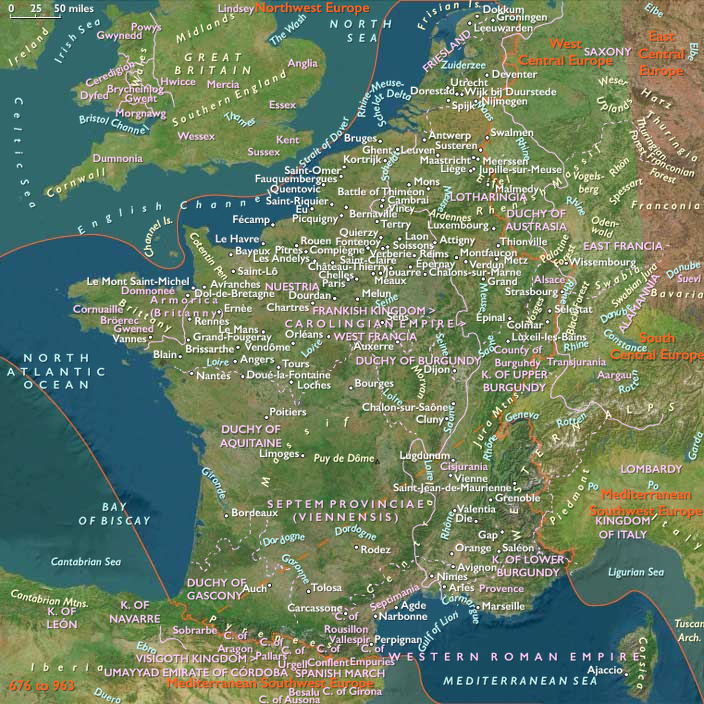
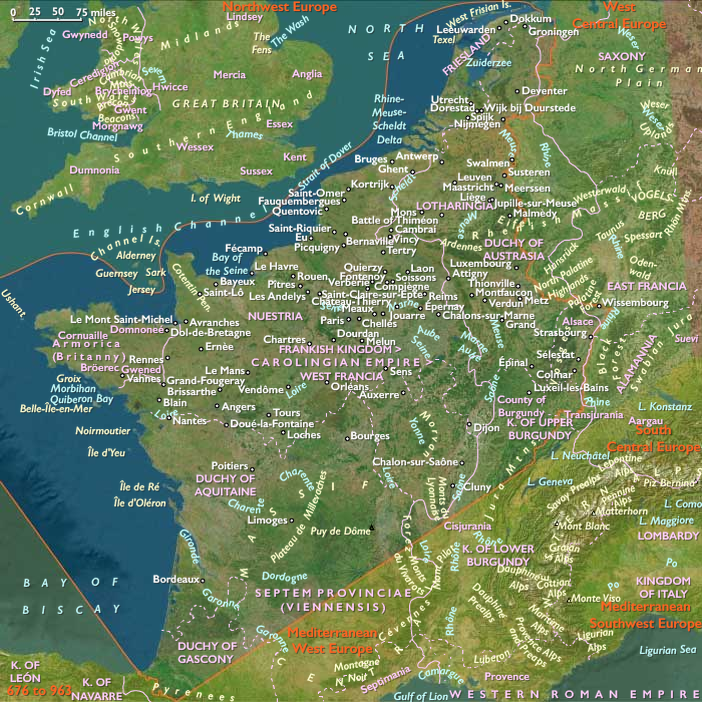
In March 845, a massive Viking fleet of 120 ships, carrying over 5,000 men, sails up the Seine River under the command of a Danish chieftain named Reginherus, or Ragnar. His identity has often been tentatively linked to the legendary Ragnar Lodbrok, though historians debate whether this is the same historical figure or if the saga character is a later mythologized version of multiple Viking leaders.
Ragnar’s History with Charles the Bald
- In 841, Charles the Bald had awarded Ragnar land in Turholt, Frisia, likely as part of a strategy to appease Viking leaders in exchange for protection or military service.
- However, Ragnar eventually loses his land and the favor of Charles, prompting him to launch a large-scale invasion of West Francia in retaliation.
The Viking Raid on Rouen and the March Up the Seine
- As the fleet moves up the Seine, the Vikings plunder Rouen, a key trade and religious center.
- The primary objective of the Viking expedition is Paris, which was not only a wealthy city but also a symbol of Frankish royal power.
Charles the Bald’s Response
- Determined to defend Paris and the royal Abbey of Saint-Denis, Charles the Bald gathers an army.
- He divides his forces, stationing one division on each side of the Seine to block Ragnar’s advance.
The Viking Attack and the Mass Execution
- Ragnar strikes first, defeating one half of the Frankish army.
- To intimidate the remaining Frankish forces, Ragnar takes 111 Frankish prisoners and hangs them on an island in the Seine.
- This ritualistic mass execution is likely done:
- As an offering to Odin, the Norse god of war and death.
- To spread terror among the remaining Frankish defenders, undermining morale.
The Consequences of the Raid
- The Viking defeat of Charles’ forces leaves Paris defenseless.
- The sack of Paris follows, leading to one of the most devastating Viking raids on West Francia.
- Charles the Bald, unable to mount an effective defense, agrees to pay a ransom of 7,000 pounds of silver (Danegeld) to persuade Ragnar to leave.
- This sets a precedent for future Viking raids, as Norse chieftains realize that the Franks are willing to pay for peace, making Francia an attractive target for future large-scale invasions.
Legacy of Ragnar’s Raid
- The 845 sack of Paris is the first recorded major Viking attack on the city, foreshadowing the larger Viking sieges of 885–886.
- The Danegeld ransom system becomes a recurring strategy in Frankish-Viking interactions, as successive Frankish rulers struggle to maintain defenses against Viking incursions.
- The Vikings become a long-term threat to the Carolingian Empire, contributing to the further weakening of royal authority and the rise of localized feudal powers.
Thus, Ragnar’s campaign in 845 not only establishes the Seine as a Viking invasion route but also marks the beginning of continuous Viking pressure on West Francia, fundamentally shaping the political and military strategies of future Carolingian rulers.
Locations
People
Groups
- Polytheism (“paganism”)
- Franks
- Christianity, Chalcedonian
- Denmark, Kingdom of
- Vikings
- Frankish, or Carolingian (Roman) Empire
- Danes (Scandinavians)
- Francia Occidentalis (West Francia, or France), Kingdom of
Topics
Commodoties
Subjects
Regions
Subregions
Related Events
Showing 10 events out of 54184 total
Years: 845 - 845
March
Locations
People
Groups
- Polytheism (“paganism”)
- Franks
- Christianity, Chalcedonian
- Denmark, Kingdom of
- Vikings
- Frankish, or Carolingian (Roman) Empire
- Danes (Scandinavians)
- Francia Occidentalis (West Francia, or France), Kingdom of
Topics
Commodoties
Subjects
Regions
Subregions