A fire in Saint Petersburg burns two …
Years: 1736 - 1736
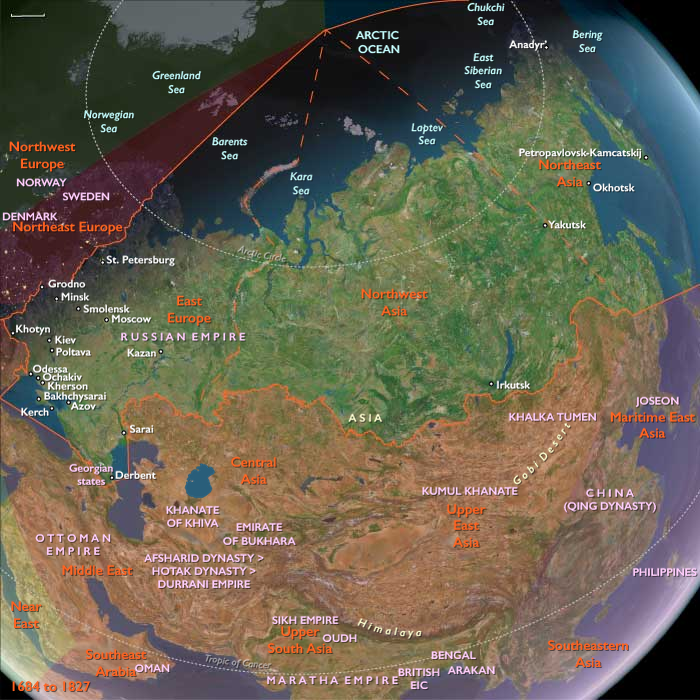
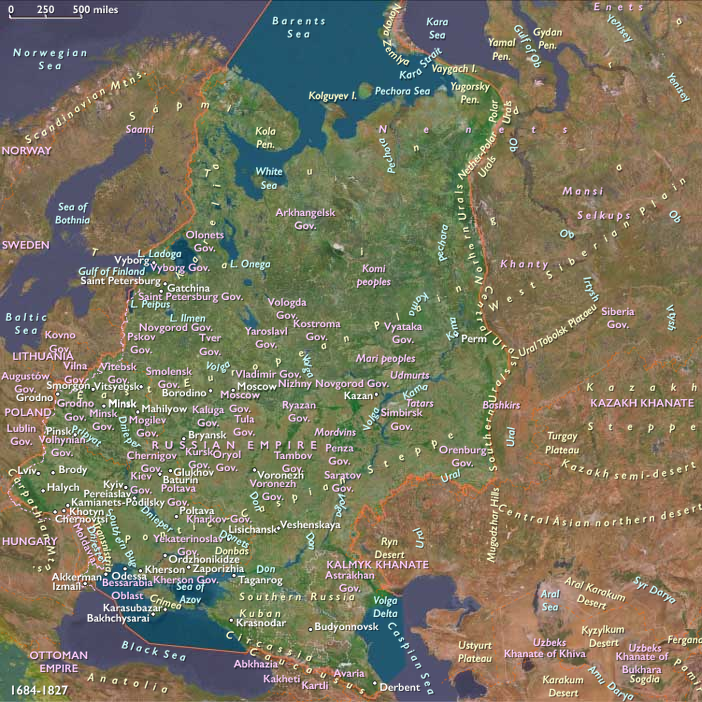
A fire in Saint Petersburg burns two thousand houses.
Locations
People
Groups
Subjects
Regions
Subregions
Related Events
Filter results
Showing 10 events out of 27501 total
Okhotsk is moved in 1736 two miles downstream to a spit of land at the mouth of the Okhota, converting the ostrog into a proper port.
The Kyōhō reforms are an array of economic policies introduced by the Tokugawa Shogunate in 1736 Japan.
Instigated by the eighth Tokugawa shogun of Japan, Tokugawa Yoshimune, the reforms, which are to encompass the first twenty years of his shogunate, are aimed at making the shogunate financially solvent.
Because of the tensions between Confucian ideology and the economic reality of Tokugawa Japan (Confucian principles that money is defiling vs. the necessity for a cash economy), Yoshimune finds it necessary to shelve certain Confucian principles that are hampering his reform process.
The Kyoho reforms include an emphasis on frugality, as well as the formation of merchant guilds that allow greater control and taxation.
Alternate attendance (sankin kōtai) rules are relaxed, and the ban on western books (minus those relating or referring to Christianity) is lifted.

The smoking of pure opium, fueled in part by the 1729 ban on madak, which had at first effectively exempted pure opium as a potentially medicinal product, becomes more popular as the eighteenth century progresses.
The smoking of pure opium, described in 1736 by Huang Shujing, the first Imperial High Commissioner to Taiwan, involves a pipe made from bamboo rimmed with silver, stuffed with palm slices and hair, fed by a clay bowl in which a globule of molten opium is held over the flame of an oil lamp.
This elaborate procedure, requiring the maintenance of pots of opium at just the right temperature for a globule to be scooped up with a needle-like skewer for smoking, forms the basis of a craft of "paste-scooping" by which servant girls can become prostitutes as the opportunity arises.
Russia, on discovering that France is seeking military aid from the Ottoman Empire during the War of the Polish Succession, had declared war on the empire in late 1735, ...
...sending armies into the Turkish areas north of the Black Sea early in 1736.
Allied with the Tatars (Tartars), the Turks inflict heavy losses on the invaders, ...
...who are compelled to withdraw into the Russian Ukraine.
The Russian Dnieper Army (sixty-two thousand men) under the command of Field Marshal Burkhard Christoph von Munnich on May 20, 1736, takes by storm the Turkish fortifications at Perekop and on June 17 occupies Bakhchisaray.
However, lack of supplies coupled with the outbreak of an epidemic forces Münnich to retreat to Ukraine.
The Russian Don Army (twenty-eight thousand men) under the command of General Peter Lacy with the support from the Don Flotilla under the command of Vice Admiral Peter Bredahl, on June 19 seizes the fortress of Azov.
Pierre de Fermat had first stated the theorem known as Fermat’s Little Theorem, the basis for the Fermat primality test and one of the fundamental results of elementary number theory, in a letter dated October 18, 1640, to his friend and confidant Frénicle de Bessy as the following: p divides a p−1 − 1 whenever p is prime and a is coprime to p. As usual, Fermat did not prove his assertion, only stating: Et cette proposition est généralement vraie en toutes progressions et en tous nombres premiers; de quoi je vous envoierois la démonstration, si je n'appréhendois d'être trop long. (And this proposition is generally true for all progressions and for all prime numbers; the proof of which I would send to you, if I were not afraid to be too long.)
Euler first publishes a proof in 1736 in a paper entitled "Theorematum Quorundam ad Numeros Primos Spectantium Demonstratio", but Leibniz had left virtually the same proof in an unpublished manuscript from sometime before 1683.
The French Academy of Sciences expedition led by Pierre Louis Maupertuis, with Anders Celsius, begins work on measuring a meridian arc in the Torne Valley of Finland.
Neustrelitz (New Strelitz), which becomes the official capital of Mecklenburg-Strelitz in 1736, has been built around the hunting lodge at the lake called Zierker See to the northwest of Strelitz, where the duke and his family have lived since the castle and the town of Strelitz had burnt down in 1712.