
A drought in 914 leads to a …
Years: 915 - 915
August
A drought in 914 leads to a terrible famine in the Iberian peninsula that continues in 915.
In Al-Andalus, the large numbers of Christians adopting Islam prompts concern among the authorities about the weakening of the tax base and further inflames resentment towards the Muladi.
Locations
People
Groups
- Arab people
- Berber people (also called Amazigh people or Imazighen, "free men", singular Amazigh)
- Moors
- Christianity, Chalcedonian
- Muslims, Sunni
- Mozarabs
- Córdoba, Umayyad Emirate of
- Muladi
Topics
Commodoties
Subjects
Regions
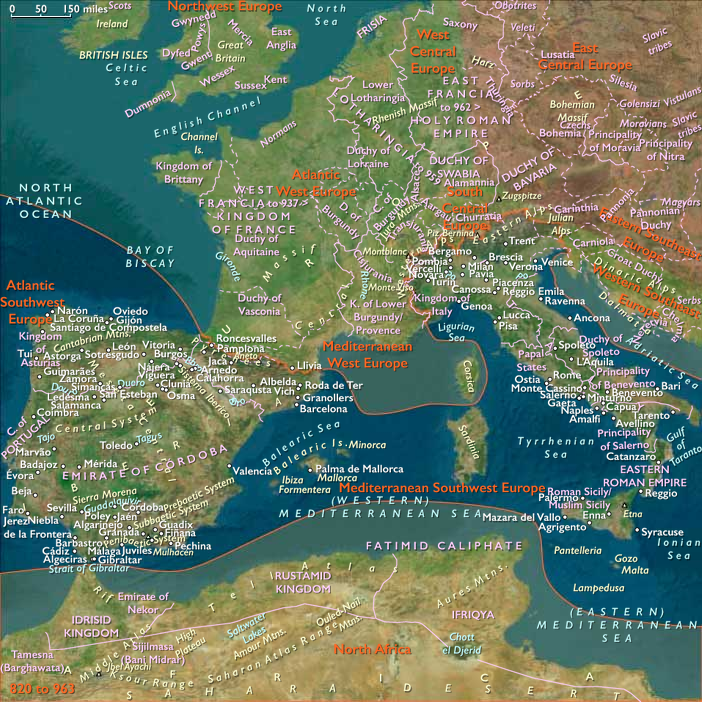
Subregions
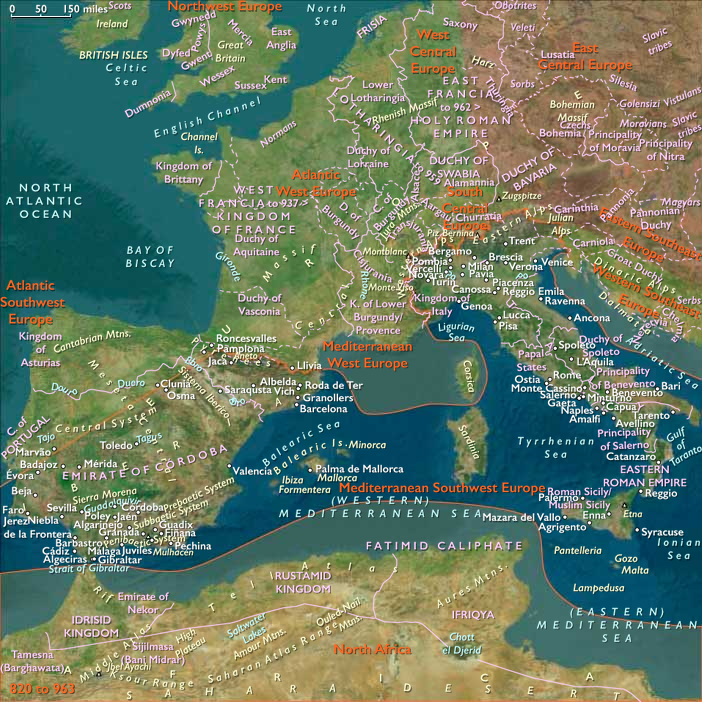
Related Events
Filter results
Showing 10 events out of 53358 total
The Magyars have entirely taken over the Plain of Hungary by 915.
The Gurjara Pratihara ruler Mahipala I is experiencing some family feuds, providing Indra III an opportunity to attack Kannauj.
From the writings of Kannada poet Adikavi Pampa, it is known that Indra III had sent his feudatory, Chalukya King Narasimha of Vemulavada (Andhra region) in pursuit of Mahipala I, the incumbent ruler, who flees the area.
The northern campaign of Indra III produce more dramatic results than during the rule of Dhruva Dharavarsha and Govinda III, as the Rashtrakutas will actually be able to hold Kannauj until 916.
The Abbasid troops hold Fustat; the Fatimids’ Berber cavalry suffers heavy losses from the Turkish archers.
The campaign into Egypt falters against the resistance of the Abbasids, with heavy casualties.
Al-Qa'im and Husaba are forced to withdraw with their forces to Ifriqiya.
The forces of the new imperial strategos of Bari, Nicholas Picingli, join those of various other south Italian princes of Lombard or Greek extraction: Landulf I of Benevento, John I and his son Docibilis II of Gaeta, Gregory IV and John II of Naples, and Guaimar II of Salerno.
Meanwhile, Berengar brings with him troops from the northern parts of Italy, and the campaign is coordinated by John X, who takes to the field in person, alongside Duke Alberic I of Spoleto.
After some preliminary engagements at Campo Baccano and at Trevi, the Saracens are driven to their stronghold on the Garigliano.
Here, at the Battle of Garigliano, the allies proceed to lay siege to them for three months, at the end of which the Saracens burn their houses and attempt to burst out of the encirclement.
With Pope John leading the way, all are eventually caught and killed, achieving a great victory and removing the ongoing Saracen threat from the Italian mainland.
John then confirms the granting of Traetto to John I of Gaeta, as a reward for abandoning his Saracen allies.
John of Gaeta can expand his duchy to the Garigliano, and receives the title of patricius from Constantinople, leading his family to proclaim themselves "dukes", while Alberic's prestige after the victorious battle grants him a preeminent role in the future history of Rome.
King Berengar, ever since he had defeated and driven the Roman Emperor Louis the Blind out of Italy in 905, has eagerly pressed for the imperial crown.
John X had used this as a lever to push Berengar into supporting and providing troops to John’s great Saracen campaign.
Having completed his end of the bargain, Berengar now insists that John do likewise.
Thus, in December 915, Berengar approaches Rome, and after being greeted by the family of Theophylact (whose support he secures), he meets Pope John at St. Peter’s Basilica.
On Sunday, December 3, John crowns Berengar as Roman Emperor, while Berengar in turn confirms previous donations made to the See of Peter by earlier emperors.
Solomon III, bishop of Constance, is a warlike prelate, originally an ally of both King Louis the Child and Count Palatine Erchanger in the wars for the Swabian dukeship against the Burchards.
He had been influential in the execution of Burchard I in 911, but had left his alliance with Erchanger when the latter allied with King Conrad I.
Erchanger had even imprisoned Solomon in 914.
Conrad, however, supports the bishop and frees him.
Burchard II, who has allied himself with king Conrad I, defeats his rivals for the rule of Alamannia in a battle at Wahlwies in the Hegau in 915.
Conrad will later have Erchanger beheaded.
The absence of royal authority enables Ordoño II to easily campaign in this area, his main objective being the city of Mérida, in the summer of 915.
Abd ar-Rahman III does not send an army and only several local Berber chiefs offer a futile resistance.
Other Muladi revolts have occurred throughout Al-Andalus.
In the Elvira region, for instance, discord had sprung up between the Muladi and Moors, the latter being led by Sawar ibn Hamdub, and the poet, Sa'ad ibn Judi, both of whom fluctuate between insurrection against the caliph and submission to him.
The region of Valencia submits peacefully to Abd ar-Rahman in 915.
East Central Europe (916–927 CE): Establishment of the Magyar Principality, Ascendancy of Saxony under Henry the Fowler, and the Rise of the Přemyslid State
Between 916 and 927 CE, East Central Europe—comprising modern-day Poland, Czechia, Slovakia, Hungary, and eastern portions of Germany and Austria east of 10°E and north of a line from approximately 48.2°N at 10°E to the Austro-Slovenian border near 46.7°N, 15.4°E—underwent major transformations shaped by the establishment of a powerful Magyar principality, the ascendancy of Saxony under Henry the Fowler, and the formation of the Bohemian Přemyslid state. These significant developments marked the emergence of new medieval political entities, stabilizing the region after decades of turmoil and laying foundational structures that would define East Central Europe for centuries.
Political and Military Developments
Formation of the Magyar Principality
-
Under Árpád's successors, the Magyars solidified their control over the Carpathian Basin, creating a formidable political and military power capable of both internal consolidation and extensive raiding expeditions across Europe, significantly reshaping regional power dynamics.
Saxon Ascendancy under Henry the Fowler
-
Henry the Fowler (r. 919–936), succeeding his father Otto the Illustrious as Duke of Saxony and elected King of East Francia in 919, dramatically strengthened Saxon political and military authority. His reign marked the definitive rise of the Liudolfing (Ottonian) dynasty, significantly fortifying East Francia's eastern frontiers.
Emergence and Consolidation of the Přemyslid State
-
In Bohemia, the Přemyslid dynasty emerged prominently under Duke Wenceslaus I (r. c. 921–935), consolidating political authority, integrating local Slavic tribes, and establishing a nascent state structure that would profoundly shape Bohemian medieval history.
Economic and Technological Developments
Economic Stabilization and Trade Revival
-
With more stable regional political entities emerging, disrupted trade networks gradually revived, facilitating renewed economic activity in Bavaria, Saxony, and Bohemia, centered on agriculture, metalworking, and expanding long-distance commerce.
Expansion of Defensive Infrastructure
-
Henry the Fowler notably fortified East Francia’s eastern frontier, erecting extensive defensive systems, fortresses, and fortified towns, notably against persistent Magyar threats, significantly influencing military and urban development across Saxony and eastern Bavaria.
Cultural and Artistic Developments
Magyar Cultural Integration
-
Settled in the Carpathian Basin, the Magyar elite began assimilating local and regional cultural influences, creating a distinctive synthesis evident in artifacts, burial practices, and early settlement structures.
Saxon Ecclesiastical Patronage and Cultural Growth
-
Henry the Fowler’s reign saw extensive ecclesiastical patronage and cultural flourishing, reflected in manuscript production, monastic foundation, and artistic achievements, further solidifying Saxon cultural identity and Christian integration.
Bohemian Cultural and Religious Consolidation
-
Under the Přemyslids, Bohemian cultural identity deepened, with significant ecclesiastical patronage and consolidation of Slavic Christian traditions originally fostered by the Moravian missions, creating a lasting religious-cultural framework.
Settlement and Urban Development
Magyar Settlement Consolidation
-
Permanent Magyar settlements developed, notably around strategic locations such as Esztergom and Székesfehérvár, becoming important administrative, military, and cultural centers in early medieval Hungary.
Fortified Urban Centers in Saxony and Bavaria
-
Henry the Fowler systematically expanded and fortified key Saxon and Bavarian urban centers, significantly improving regional security and economic vitality, setting the foundations for medieval German urbanization.
Growth of Přemyslid Political and Ecclesiastical Centers
-
Emerging Bohemian centers like Prague became focal points for political, administrative, and ecclesiastical activities, initiating a sustained period of urban and regional development under Přemyslid leadership.
Social and Religious Developments
Reinforcement of Christian Institutions
-
The period witnessed strengthened ecclesiastical networks throughout Saxony, Bavaria, and Bohemia, embedding Christianity deeper into regional identities, social practices, and political institutions.
Formation of Distinct Regional Identities
-
The consolidation of distinct identities—Magyar, Saxon, and Bohemian—through dynastic rule, religious affiliations, and cultural traditions marked the formative phase of lasting regional and national communities in East Central Europe.
Long-Term Consequences and Historical Significance
The era 916–927 CE established crucial political, cultural, and social foundations for medieval East Central Europe. The solidification of Magyar power, the decisive ascendancy of Saxony under Henry the Fowler, and the formation of the Přemyslid state defined clear political entities, stabilizing the region after prolonged instability. These formative developments significantly influenced the medieval trajectory of East Central Europe, shaping future dynastic, cultural, and geopolitical landscapes.
Years: 915 - 915
August
Locations
People
Groups
- Arab people
- Berber people (also called Amazigh people or Imazighen, "free men", singular Amazigh)
- Moors
- Christianity, Chalcedonian
- Muslims, Sunni
- Mozarabs
- Córdoba, Umayyad Emirate of
- Muladi
