A dispute in 1058 between members of …
Years: 1058 - 1058
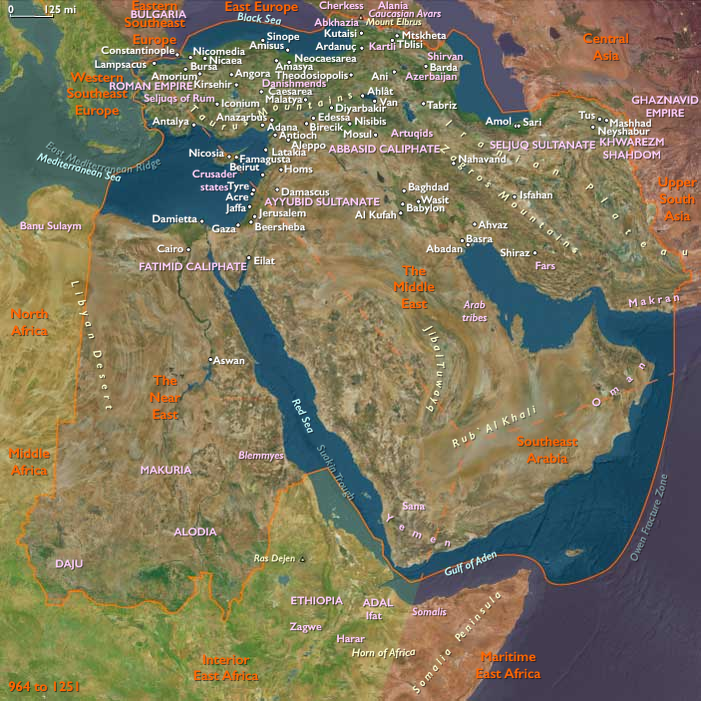
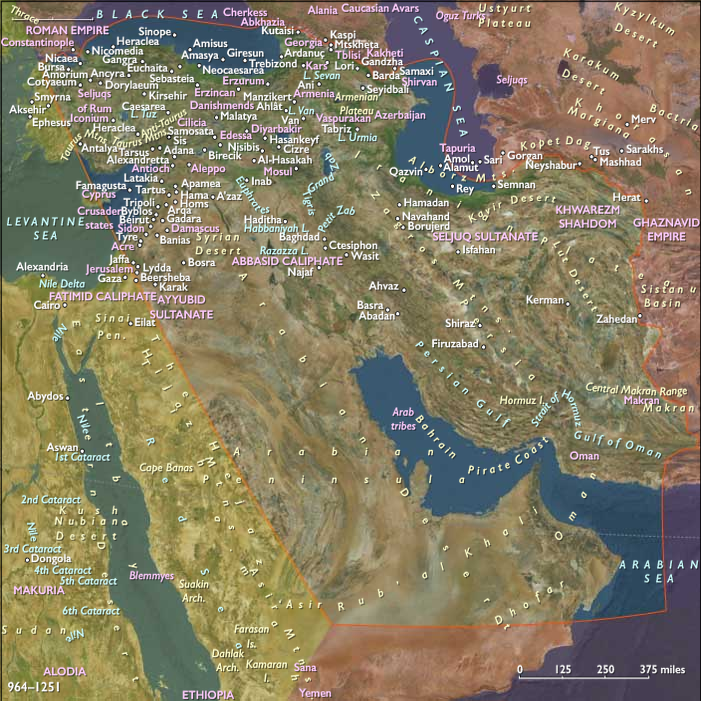
A dispute in 1058 between members of the Abd al-Qays tribe and the millenarian Ismaili Qarmatian state prompts a revolt in Bahrain led by Abu al-Bahlul al-Awwam, who, along with his brother, Abu'l-Walid Muslim, had called for the khutba in Bahrain to be read in the name of the Abbasid caliph al-Qaim, a common way of expressing allegience to the Abbasids, which is anathema to the millenarian Qarmatian Ismailis.
Their rebellion quickly overthrows Qarmatian rule in the islands and leads to the unraveling of the Qarmatian state.
Locations
People
Groups
- Arab people
- Persian people
- Berber people (also called Amazigh people or Imazighen, "free men", singular Amazigh)
- Oghuz Turks
- Muslims, Sunni
- Muslims, Shi'a
- Ismailism
- Qarmatians
- Abbasid Caliphate (Baghdad)
- Mazyadid (Al-Mazeedi) state of Iraq
- Turkmen people
- Fatimid Caliphate
- Seljuq Empire (Isfahan)
Commodoties
Subjects
Regions
Subregions
Related Events
Filter results
Showing 10 events out of 51072 total
Bao Zheng, according to the History of Song, was born into a scholar family in Luzhou District (now Hefei District, Anhui Province).
Bao's family was middle class, and although Bao's parents could afford to send him to school, his mother had to climb up mountains to collect firewood just before she gave birth to him.
As Bao had grown up among low working class, he well understands people's hardships, hates corruption and strongly desires justice.
At the age of twenty-nine, Bao had passed the highest-level imperial examination and became qualified as a Jinshi.
Appointed as Magistrate of Jianchang County he had deferred embarking on his official career for a decade in order to care for his elderly parents and faithfully observe proper mourning rites after their deaths.
During the time Bao looked after his parents at home, Liu Yun, Magistrate of Luzhou, who was renowned as an excellent poetic and fair-minded officer, usually visited Bao.
Because the two got along well, Bao obtained great influence from Liu Yun in respect of the love for people.
After his parents' demise, Bao, now forty, had been reappointed as Magistrate of Tianchang District.
Since Bao had proved to be a good public officer, he has been promoted to higher offices successively.
While at the post in Duanzhou, famous for its inkstones, Bao had discovered that previous magistrates always collected more inkstones than allowed.
Bao had stopped the practice and left without a single inkstone in his possession once his tenure was over.
During his years in the government service, Bao has had thirty high officials demoted or dismissed for corruption, bribery, or dereliction of duty.
He also had had Zhang Yaozhuo, the uncle of a highly ranked imperial concubine, impeached for six offenses.
In addition, as the imperial censor, Bao has avoided punishment despite having many other contemporary imperial censors punished for minor statements.
Bao had been appointed the Magistrate of the Capital City of Bian (now Kaifeng) in 1057.
Bao holds the position for a merely a year, but he initiates several material administrative reforms, including allowing the citizens to directly lodge complaints with the city administrators, thereby bypassing the city clerks who are believed to be corrupt and in the pay of local powerful families.
Although Bao gains much fame and popularity from his reforms, his service after his tenure as Magistrate of Bian is controversial.
For example, when Bao dismisses Zhang Fangping, who concurrently holds three important offices, Bao is appointed to these offices as Zhang's successor.
Ouyang Xiu then files a rebuke against Bao.
Bao had also been the Minister of Finance.
Despite his high rank in the government, Bao leads a modest life like a commoner.
Apart from his intolerance of injustice and corruption, Bao is well-known for his filial piety and his stern demeanor.
In his lifetime, Bao gains he name "Iron-Faced Judge" and it is also said among the public that his smile is "rarer than clear waters in the Yellow River".
Due to his fame and the strength of his reputation, Bao's name will become synonymous with the idealized "honest and upright official" (qing guan), and will quickly become a popular subject of early vernacular drama and literature.
Bao will also be associated with the god Yanluo (Yama) and the "Infernal Bureaucracy" of the Eastern Marchmount, on account of his supposed ability to judge affairs in the afterlife as well as he judged them in the realm of the living.

Spytihnev’, his brothers having inherited Moravia, tries to reduce their authority by arresting three hundred Moravian magnates and stripping his brothers of their rights in the province.
Thus, Vratislaus of Olomouc flees to Hungary in 1058.
Casimir, aided by his Kievan brother-in-law Vladimir, had started a war against Masovia in 1047 and seized the land.
It is probable that he also defeated Mieclaw's allies from Pomerania and attached Gdańsk to Poland.
This had secured his power in central Poland.
Three years later, against the will of the Emperor, Casimir had seized Bohemian-controlled Silesia, thus securing most of his father's domain.
The Emperor had ruled in 1054 in Quedlinburg that Silesia was to remain in Poland in exchange for a yearly tribute of one hundred and seventeen kilograms of silver and seven kilograms of gold.
Casimir had at that time focused on internal matters.
To strengthen his rule, he had re-created the bishopric in Kraków and Wrocław and erected the new Wawel Cathedral.
During Casimir's rule heraldry has been introduced into Poland and, unlike his predecessors, he promotes landed gentry over the drużyna as his base of power.
One of his reforms is the introduction, to Poland, of a key element of feudalism: the granting of fiefdoms to his retinue of warriors, thus gradually transforming them into medieval knights.
Following the death of Casimir in 1058, Boleslaw II, as the eldest son, inherits Greater and Lesser Poland as well as the Mazovian, Pomeranian, and Silesian lands.
His younger brothers Władyslaw Herman and Mieszko become governors of the remaining provinces.
The first Germanic people to settle in Burgenland, today the easternmost and least populous state (or Land) of Austria, were the Ostrogoths, who came to Pannonia in CE 380.
The Ostrogoths became allies of Rome and were allowed to settle in Pannonia, being tasked to defend the Roman borders.
The area had been conquered in the fifth century by the Huns, but after their defeat, an independent Kingdom of the Ostrogoths in Pannonia had been formed.
The territory of present-day Burgenland became part of the Italian Kingdom of Odoacer, but at the end of the fifth century the Ostrogothic king Theodoric had conquered this kingdom and restored Ostrogothic administration in western Pannonia.
In the sixth century, the territory was included in another Germanic state, the Kingdom of the Lombards.
However, the Lombards subsequently left for Italy and the area came under the control of the Avars.
Briefly in the seventh century, the area was part of the Slavic State of Samo, but was subsequently returned to Avar control.
The area became part of the Frankish Empire after the Avar defeat at the end of the eighth century.
There had been a peace treaty in 1054 between Henry III (who later in the same year married Agnes de Poitou, a daughter of the Duke of Aquitaine) and King Samuel Aba of Hungary, whose descendants owned large estates in western Slavonia and whose relative later married a daughter of Agnes of Poitou.
This treaty had fixed the western border of the Kingdom of Hungary along the Leitha and Lafnitz rivers, among others, but large parts of the territory of today's Burgenland will be owned from then until the Treaty of Brétigny in 1360 by the noble family of the House of Gilet, which originates from the Duchy of Aquitaine in Medieval France in the reign of Robert II of France; thus Fraknó (Forchtenstein) will become owned by the Curia Regia (Royal Court of Hungary) in 1360.
On September 20, 1058 Agnes of Poitou, as regent for Emperor Henry IV, and Andrew I of Hungary, whose son will later marry a daughter of Agnes of Poitou, meet to negotiate the border.
The region of Burgenland will remain the western border-zone of the medieval Kingdom of Hungary until the sixteenth century.
Cerularius, having had a role in bringing Isaac I Komnenos to the throne, next quarrels with the emperor over his stringent financial policies, including the confiscation of some church property, and over the Patriarch's attempt to subordinate civil power to the church.
Michael goes so far as to take the highly symbolic step of donning the purple shoes ceremonially reserved for the Emperor.
Michael apparently plans a rebellion to overthrow the Emperor and claim the Imperial Throne for himself or for his relative Constantine Doukas.
Isaac exiles Michael to Proconnesus in 1058 and, as Michael refuses to step down, has Michael Psellos draw up an accusation of heresy and treason against him.
A similar rebellion takes place in Qatif in 1058, forcing the Qarmatians back to Al-Hasa.
Abul Ala, later to be known as al-Maʿarri, was born in Maʿarra (now Ma'arat al-Nu'man), Syria (region).
He is a member of the Banu Sulayman, a notable family of Maʿarra, belonging to the larger Tanukh tribe.
His paternal great-great-grandfather had been the city's first qadi.
Some members of the Bany Sulayman had also been noted as good poets.
He had lost his eyesight at the age of four due to smallpox.
He had started his career as a poet at an early age, at about eleven or twelve years old.
He had been educated at first in Maʿarra and Aleppo, later also in Antioch and other Syrian cities.
Among his teachers in Aleppo were companions from the circle of Ibn Khalawayh.
This grammarian and Islamic scholar had died in 980/981, when Al-Maʿarri was still a child.
Al-Maʿarri nevertheless laments the loss of Ibn Khālawayh in strong terms in a poem of his Risālat al-ghufrān.
Al-Qifti reports that when on his way to Tripoli, Al-Maʿarri visited a Christian monastery near Latakia where he listened to debates about Hellenic philosophy, which planted in him the seeds of his later skepticism and irreligiosity; but other historians such as Ibn al-Adim deny that he had been exposed to any theology other than Islamic doctrine.
He had also spent eighteen months at Baghdad, where he was well received in the literary salons of the time.
He had returned to his native town of Maʿarra in about 1010 blaming his return on a lack of money and hearing that his mother was ill (she died before he arrived).
He remains in Ma'arra for the rest of his life, where has opted for an ascetic lifestyle, refusing to sell his poems, living in seclusion and observing a strict vegan diet.
He nevertheless enjoys great respect and attracts many students locally, as well as actively holding correspondence with scholars abroad.
Al-Maʿarri is a skeptic in his beliefs and denounces superstition and dogmatism in religion.
Thus, he has been described as a pessimistic freethinker.
One of the recurring themes of his philosophy is the rights of reason against the claims of custom, tradition, and authority.
Al-Maʿarri teaches that religion is a "fable invented by the ancients", worthless except for those who exploit the credulous masses.
He criticizes many of the dogmas of Islam, such as the Hajj, which he calls "a heathen's journey."
He rejects claims of any divine revelation.
His creed is that of a philosopher and ascetic, for whom reason provides a moral guide, and virtue is its own reward.
Al-Maarri's fundamental pessimism is expressed in his anti-natalist recommendation that no children should be begotten, so as to spare them the pains of life.
In an elegy composed by him over the loss of a relative, he combines his grief with observations on the ephemerality of this life.
His religious skepticism and positively anti-religious views are expressed in a poem which states, "The inhabitants of the earth are of two sorts: those with brains, but no religion, and those with religion, but no brains."
He is equally sarcastic towards the religion of Islam as he is towards Judaism and Christianity.
Al-Ma'arri remarks that monks in their cloisters or devotees in their mosques are blindly following the beliefs of their locality: if they were born among Magians or Sabians they would have become Magians or Sabians.
He dies at an advanced age in 1058.
Gisulf’s enmity with the Normans had soon cost him.
Robert Guiscard had sallied forth from his Calabrian castle at San Marco and captured the Salernitan town of Cosenza and several of its neighbors.
Gisulf had soon raised the ire of Count Richard I of Aversa and, only by alliance with the despised Almafitans, could he retain his throne.
The predations of William, Count of the Principate, a brother of Robert Guiscard, forces him to marry his sister Sikelgaita to Guiscard in return for protection.
(He will eventually marry his sister Gaitelgrima to Jordan, the son of Richard, recently prince of Capua.)
Sikelgaita’s marriage to Guscard takes place after Robert divorces his first wife Alberada, due to supposed consanguinity.
Her sister Gaitelgrima had earlier married Robert's half-brother Drogo.
The divorce from Alberada and the marriage of Sikelgaita are probably part of a strategy of alliance with the remaining Lombard princes, of whom Guaimar is chief.
Alberada, for her part, appears to have had no qualms about dissolving her marriage.
Robert, having become the recognized leader of the Apulian Normans, resumes his campaign in Calabria.
The arrival from Normandy of his younger brother Roger enables him to extend and solidify his conquests in Apulia.
In 1058, Guiscard effects an uneasy reconciliation with Gisulf II, by dissolving his first marriage to Alberada, the mother of his son Bohemond, and marrying Gisulf's sister, Sigelgaita.
Abdallah ibn Yasin, by negotiation, secures an alliance with the Masmuda Berbers of the High Atlas, which allows the Almoravids to cross the mountain range with little incident and seize the critical Zenata-ruled citadel of Aghmat in 1058 with little opposition.
Years: 1058 - 1058
Locations
People
Groups
- Arab people
- Persian people
- Berber people (also called Amazigh people or Imazighen, "free men", singular Amazigh)
- Oghuz Turks
- Muslims, Sunni
- Muslims, Shi'a
- Ismailism
- Qarmatians
- Abbasid Caliphate (Baghdad)
- Mazyadid (Al-Mazeedi) state of Iraq
- Turkmen people
- Fatimid Caliphate
- Seljuq Empire (Isfahan)