A dispute between Hosokawa Katsumoto and Yamana …
Years: 1467 - 1467
January
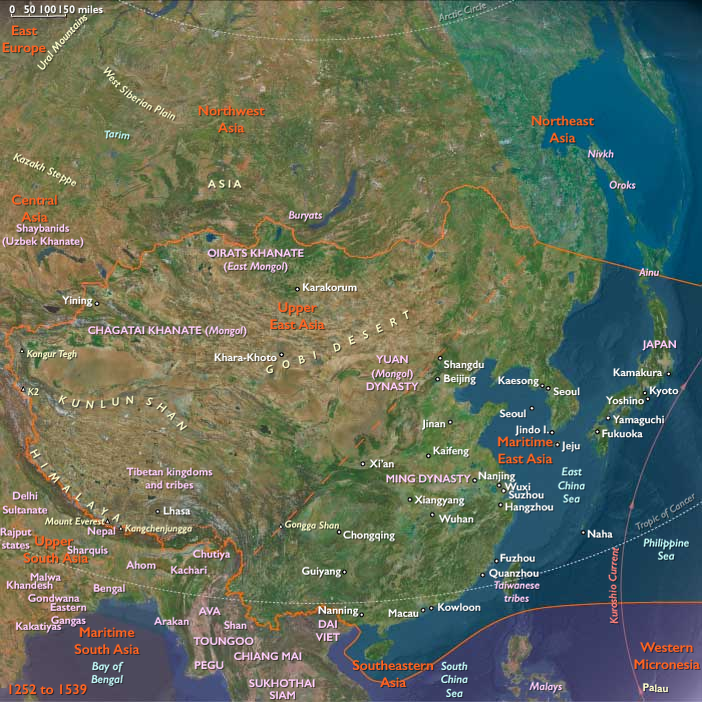
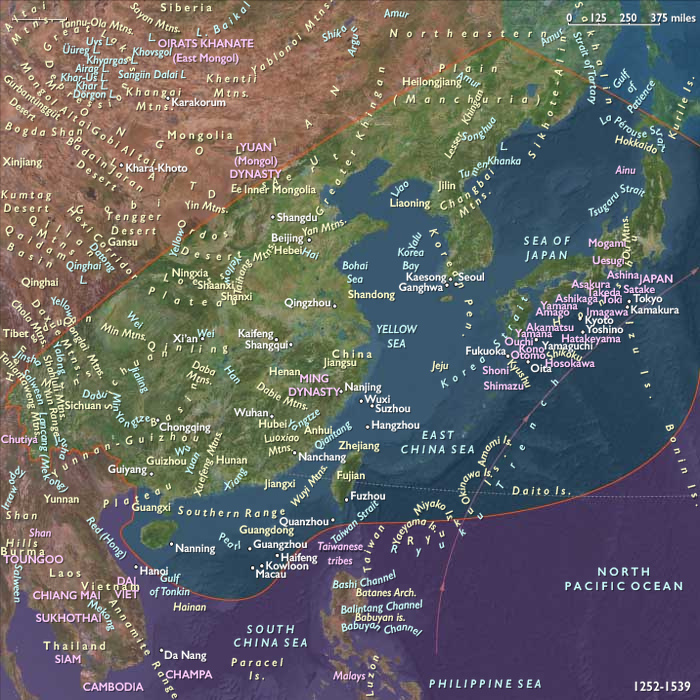
A dispute between Hosokawa Katsumoto and Yamana Sōzen, which begins in 1467, will escalate into a nationwide war involving the Ashikaga shogunate and a number of daimyo in many regions of Japan, initiating Japan’s Sengoku jidai, "the Warring States Period".
The deposed shogun Yoshiyoshi had turned to Yamana Sozen Mochitoyo for help in 1466.
Yamana and Hino Tomiko, the official wife of Yoshimasa, influence the shogun to remove Hatakeyama Masanaga as Kanrei in January of 1467.
In response, Masanaga and Hosokawa Katsumoto, Yamana’s son-in-law, raise an army.
Locations
People
Groups
Topics
Commodoties
Subjects
Regions
Subregions
Related Events
Filter results
Showing 10 events out of 41051 total
Sesshu Toyo had begun his painting career at the Kyoto temple, Shokokuji, as a pupil of Shubun, and had moved around 1463 to western Japan, where he had entered the service of the powerful Ouchi clan.
Based in Suo Province, towards the western end of Honshu, the Ouchi are among the primary families to be involved in foreign trade and relations, particularly with China.
While accompanying an Ouchi trade mission to China in about 1467, Sesshu enriches his art by experiencing (as he will later write) the grandiose nature of China.
The fragile peace between Moscow and the Tatars is broken in 1467, when Ivan decides to support his ally Qasim's claims to the Tatar throne of Kazan and declares war on the ruling khan Ibrahim.
Ivan's army sails down the Volga, with their eyes fixed on Kazan, but autumn rains and rasputitsa—the semiannual mud season—hinder the progress of the Russian forces.
When frosty winter comes, the Russian generals launch an invasion of the northern Vyatka Region.
The campaign falls apart for lack of unity of purpose and military capability, but many atrocities are reported when the Russian army devastates Udmurtia.
Erik Axelsson Tott, who had replaced Jöns Bengtsson Oxenstierna as Regent of Sweden in 1466, had opposed his older kinsman the king in 1457 when he as king had gathered much dissatisfaction among Swedish high nobility.
In 1467 Eric reverts, yet again supporting Charles, in his third election to the Swedish throne.
The locals of Transylvania start an uprising in 1467, and Corvinus has a difficult time in quelling the riots.
He later discovers that Stephen had supported the rioters, probably in order to find and kill Aron.
The Hungarians recruit an army of forty thousand, many drawn locally from Transylvania.
Many knights and Hungarian aristocrats follow, one of them being Stefan Báthory, who will one day rule Transylvania.
With them, they bring five hundred cannon and other heavy siege equipment.
The Moldavians, being fewer in number and seeing that the Hungarians are determined to wage war, start to evacuate the population close to the Hungarian border and blockade the passages by cutting down trees and placing them on the roads.
The Hungarians depart in the middle of October and reach the realm of Moldavia at the beginning of November, using a passage near Bacău.
On November 19, the Hungarians arrive at the Trotuș River, where they meet some Moldavian resistance.
The town is destroyed and the Hungarians head for Bacău, which they also burn down; they then continue to …
…Roman and stay there between November 29 and December 7.
Roman is put to the torch and the Hungarians kill everyone they encounter.
After three days of marching and more pillaging, …
…the Hungarians reach Baia, where Corvinus meets with a Hungarian by the name of Sythotus, who reveals to him the Moldavian position, their numbers (twelve thousand), and their plan to attack before dusk.
The Moldavians are encamped further north, between Moldova River and Șomuz creek.
Corvinus orders the city to be fortified as the men are told to be prepared for battle and guards are sent to man strategic points.
On December 15, when dusk is approaching, Stephen sends smaller detachments that set the town on fire from three different places: noise and confusion set in.
Stephen orders his men to dismount; soon after, they launch their attack and battle until dawn.
Descriptions of the battle say that the fire made the night equally light as the day and that many Hungarians were consumed by the flames.
The two armies start to butcher each other at the gate of the city; the fierce fighting then continued onto the streets.
The Moldavians gain the upper hand and launch another attack against the royal guard, which consists of two hundred heavily armed knights, the aristocrats and Corvinus.
Many Moldavians are killed in the tumult that followd, as Báthory and the rest of the knights try to defend the entrance to the market.
Corvinus is wounded by three arrows in the back and has to be carried from the battlefield.
Around ten thousand Hungarians are said to have been killed; most of the barons escape with their king.
A Hungarian chronicle mentions seven thousand casualties for the Moldavians.
This chronicle is disputed, due to it being the only one mentioning the Moldavian casualties in numbers; and because the Hungarians do not have the opportunity to calculate the numbers of their fallen enemy.
The entire conflict, with the Hungarian invasion and retreat, takes around forty days.
The retreating Hungarian army, on its way to Transylvania, is stopped by a blockade; here they decide to bury the five hundred cannon and other valuables, so that the Moldavians will be unable to capture them.
Some of the captured Hungarian standards come with great troves of booty that are sent to Casimir as proof of Stephen's victory.
Corvinus, upon his return to Brașov on Christmas day, takes revenge on many of the people who had rebelled against him by torturing them to death; he then fines the Transylvanians a sum of four hundred thousand florins, which they have to pay immediately, in gold.
He will use this money to raise an army of foreign mercenaries, which will prove more loyal to him than his conscripts.
Uzun Hasan of Aq Qoyunlu, having recently gained ascendancy after defeating his rival claimants to the throne in eastern Anatolia at Diyarbakir, faces threats from the Ottoman Sultanate and the Kara Koyunlu and in wide-ranging campaigns against them has gained a reputation as a fierce fighter.
He had avoided all out war with the Ottoman Empire by allowing them to conquer his ally Empire of Trebizond, while he has consolidated his power and prepared for the defense of his territory.
It is during this time that Jahan Shah of the Kara Koyunlu wants to defeat the Aq Qoyunlu ruler and make him his vassal, so with that in mind he secures his eastern borders by a peace treaty with Abu Sa'id Mirza, the Timurid leader of Samarkand, then invades Aq Qoyunlu territory to his west.
Jahan Shah, setting out from Tabriz with a great army on May 16, 1467, had came to the basin of Lake Van.
While there, he was furious to learn that Uzun Hasan was raiding his lands with twelve thousand cavalry.
Meanwhile, Uzun Hasan, worried that Jahan Shah was planning to attack him, had carefully guarded the mountain passes.
Envoys had gone back and forth between them, but because of Jahan Shah’s heavy demands, an agreement could not be reached.
Having advanced as far as Muş, Jahan Shah had had to postpone his attack because of the onset of winter.
As his troops began to mutiny, he decided to withdraw to a winter residence.
Uzun Hassan catches his army by surprise near the sanjak of Çapakçur in present day eastern Turkey and totally defeats Jahan Shah’s forces in a sudden attack on October 30 (or November 11[2]), 1467.
Jahan Shah is killed while trying to flee, and with his death the great era of Kara Koyunlu ascendancy comes to an end.
Uzun Hasan keeps up his momentum and defeats Jahan Shah's son Hasan Ali at Marand.
Hasan Ali escapes to Khurasan and asks for aid from Abu Sa'id Mirza, who is stationed at Merv at this time.
Uzun Hasan, worried by this development, writes a letter reminding the Timurid ruler of the constant loyalty of his house to the Timurids and the disloyalty of Kara Koyunlu Abu Sa'id Mirza has his own reservations, however, about Uzun Hasan's intentions.
He also wishes to expand his territory to the extent and glory of his great-grand father, Timur Beg Gurkani.
He uses the premise of restoring Hasan Ali to his throne as a reason to invade Iran.
The expedition that follows will often be alluded to by Babur (grandson of Abu Sa'id Mirza) as the Disaster of Iraq-i-Ajam.

Needing money, the Habsburgs sell their claim on Winterthur to Zurich in 1467.
Platina is again imprisoned in 1467 on the charge of having participated in a conspiracy against the Pope, and is tortured along with other abbreviators, like Filip Callimachus (who will flee to Poland in 1478), all of whom have been accused of pagan views.
Pope Paul’s abuse of the practice of creating cardinals in pectore, without publishing their names, raises another sore point with the College of Cardinals.
Anxious to raise new cardinals to increase the number who are devoted to his interests, but restricted by the terms of the capitulation, which gives the College a voice in the creation of new members, in the winter of 1464-65 Paul had created two secret cardinals both of whom had died before their names could be published.
In his fourth year, on September 18, 1467, he creates eight new cardinals; five are candidates pressed by kings, placating respectively James II of Cyprus, Edward IV of England, Louis XI of France, Matthias Corvinus of Hungary and Ferdinand I of Naples; one is the able administrator of the Franciscans; the last two elevate his old tutor and a first cardinal-nephew.