A community for Ryukyuan envoys and scholars …
Years: 1402 - 1402
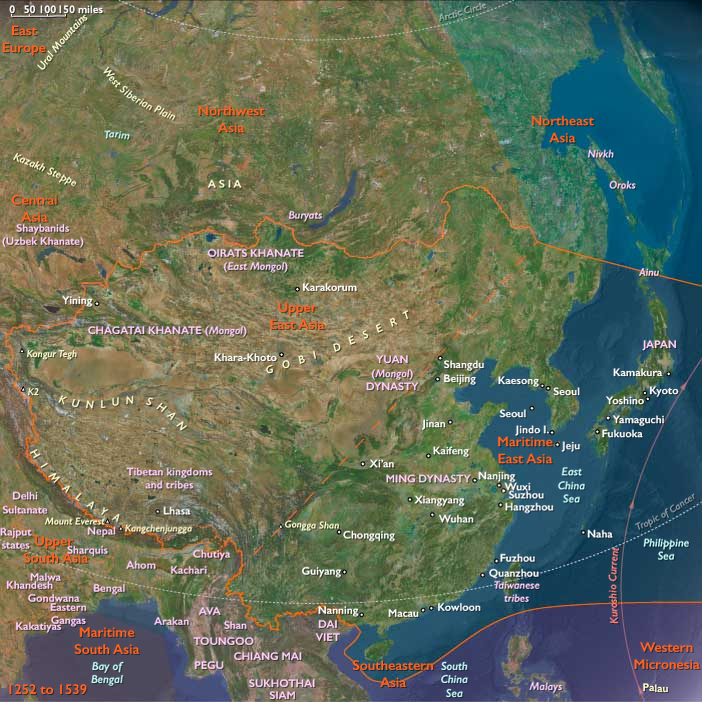
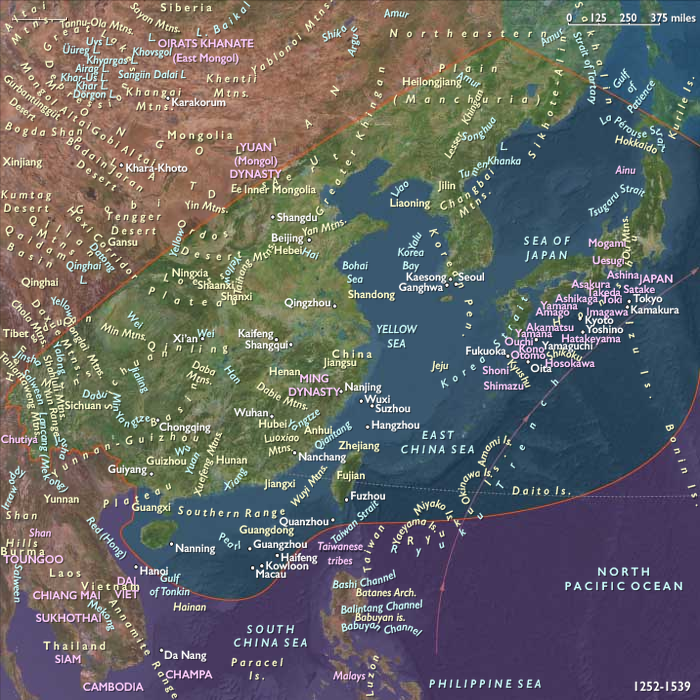
A community for Ryukyuan envoys and scholars has been similarly established in Fukien in China, and the first Ryukyuans to study in China's capital do so at this time as well, again establishing precedents for developments that will continue for centuries.
Locations
Groups
Subjects
Regions
Subregions
Related Events
Filter results
Showing 10 events out of 42692 total
Parameswara had headed north to establish a new settlement at Muar, where he had contemplates establishing his kingdom at either Biawak Busuk or at Kota Buruk.
Finding that the Muar location is not suitable, he had continued his journey northwards.
Along the way, …
…Parameswara had reportedly visited Sening Ujong (present Sungai Ujong) before reaching a fishing village at the mouth of the Bertam River (the present Malacca River).
This settlement will evolve over time to become the location of modern day Malacca Town, the capital of the Sultanate of Malacca established by Parameswara in about 1402.
Okinawa, the largest of the Ryukyu Islands, previously controlled by a number of local chieftains or lords, loosely bound by a paramount chieftain or king of the entire island, had split into three more solidly defined kingdoms within a few years after 1314; the Sanzan (Three Kingdoms) period had thus begun, and would end roughly one hundred years later.
The three kingdoms are Nanzan (Southern Mountain), Chūzan (Central Mountain) and Hokuzan (Northern Mountain).
In 1372, the kingdoms had become tributaries of China’s Ming Dynasty and had henceforth sent frequent tribute missions, relying upon the Chinese court to officially recognize each successive Ryukyuan king with a formal statement of investiture.
China is to have an incredibly strong influence on the Ryukyus for the next five hundred years, politically, economically, and culturally, as it would with its numerous other tributary states.
This period also sees the beginnings of a bureaucracy in the royal government which would later grow to rule in the king's place and in his name, replacing direct monarchical rule.
Kumemura, a community for Chinese immigrants, had been established in 1393; the Chinese living here, and their Ryukyuan descendants, are to serve Chūzan (and later the unified kingdom) as diplomats, interpreters, and government officials.
Kumemura has quickly grown into Chuzan’s cultural capital, something of a complement to the political capital at Shuri and the commercial center at the port of Naha.

Taejong, whose father is unwilling to pass over the royal seal he needs for recognition, begins to initiate policies he believe will prove his intelligence and right to rule.
One of his first acts as king had been to abolish the privilege enjoyed by the upper echelons of government and the aristocracy to maintain private armies.
His revoking of such rights to field independent forces has effectively severed their ability to muster large-scale revolts, and has drastically increased the number of men employed in the national military.
As part of a cultural project, a map of the world, the Kangnido (the full Hanja name means "Map of Integrated Lands and Regions of Historical Countries and Capitals"), is created under the supervision of two high Korean officials, and the Confucian scholar Kwon Kun.
It is the second oldest surviving world map from East Asia, after the similar Chinese Da Ming Hun Yi Tu, part of a tradition begun in the 1320s when geographical information about western countries became available via Islamic scholars in the Mongol empire.
It depicts the general form of the Old World, from Africa and Europe in the west to Japan in the east.
Although, overall, it is less geographically accurate than its Chinese cousin, most obviously in the depiction of rivers and small islands, it does feature some improvements (particularly the depictions of Korea and Japan, and a less cramped version of Africa).
Timur, having received offers of submission from the sultan of Egypt and from the imperial regent in Constantinople, returns to Samarkand in 1402 to prepare for an expedition to China.
Jadwiga's death, and with it the extinction of the Angevin line, has undermined Wladyslaw's right to the throne; and as a result, old conflicts between the nobility of Lesser Poland, generally sympathetic to Wladyslaw, and the gentry of Greater Poland have begun to surface In 1402, the king answers the rumblings against his rule of Poland by marrying Anna of Celje, a granddaughter of Casimir III of Poland, a political match that re-legitimizes his monarchy.
Another of Wladyslaw's brothers, the malcontent Švitrigaila, chooses this moment to stir up revolts behind the lines and declare himself grand duke.
On January 31, 1402, he presents himself in Marienburg, where he wins the backing of the Knights with concessions similar to those made by Jogaila and Vytautas during earlier leadership contests in the Grand Duchy.
Sigismund cooperates with the German princes in deposing his half brother, Emperor Wenceslaus, a lazy alcoholic viewed by the electors as increasingly ineffective, in 1402.
Rupert of the Palatinate is elected German king in his place.
Wenceslaus, however, is popular with his subjects despite his faults, constantly presses his claim to the German throne, and becomes increasingly influential.
Moldavia’s prince, Alexandru cel Bun (Alexander the Good), although brought to the throne in 1400 by the Hungarians (with assistance from Mircea I of Wallachia), in 1402 shifts his allegiances towards Poland, becoming a vassal of Władysław.
The Ottomans are reduced to Mongol vassals but their empire in Europe is left largely untouched.
However, Bayezid's capture by Timur has thrown the young Ottoman state into a condition of near-collapse.
At this time, a strong European crusade might manage to push the Ottomans out of Europe altogether, but weakness and division south of the Danube and diversion to other matters to the north leaves an opportunity for the Ottomans to restore what has been torn asunder without significant loss.
Internal divisions, however, are to hinder Ottoman efforts to restore their power during a period that will come to be known as the Interregnum (1402-13), during which four of Bayezid's sons will compete for the right to rule the entire empire.
His eldest son Süleyman has assumed control in Rumelia (Balkan lands under Ottoman control), establishing a capital at Edirne, and gained the support of the Christian vassals and those who had stimulated Bayezid to turn toward conquest in the East.