
A city on the site of present …
Years: 885BCE - 874BCE
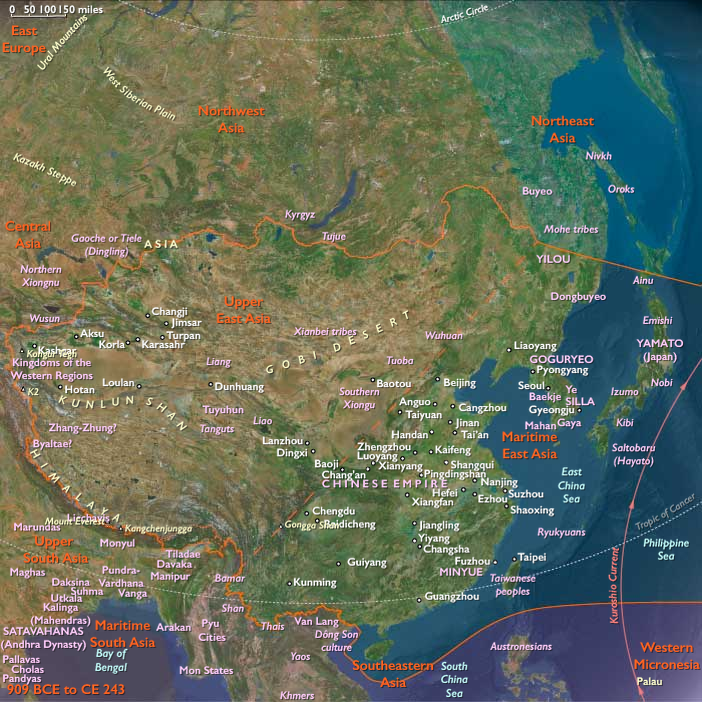
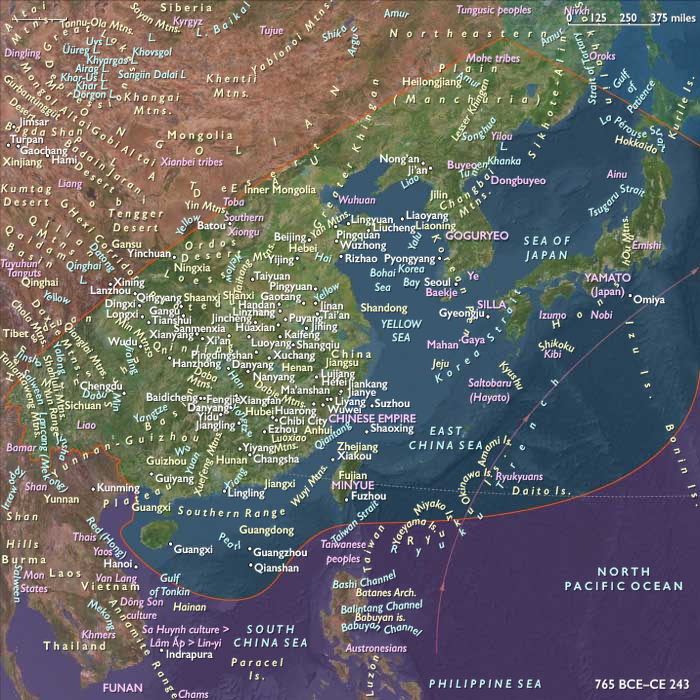
A city on the site of present Guangzhou (formerly known as Canton), situated eighty miles (one hundred and thirty kilometers) inland from the South China Sea at the northern apex of the Pearl (Zhu, or Chu) River delta, which is built up by the West (Xi; Hsi), North (Bei; Pei), and East (Deng; Tung) rivers, may have been established as early as 887.
Guangzhou is today the third largest city in China and southern China's largest city.
As of the 2010 census, the city had a population of 12.78 million.
Locations
Groups
Topics
Subjects
Regions
Subregions
Related Events
Filter results
Showing 10 events out of 66612 total
There are wars in the south during the reign of King Yi, the ninth sovereign of the Chinese Zhou Dynasty,twith the State of Chu and the southern branch of the Dongyi, a collective term for people in eastern China and in lands located to the east of ancient China.
King Yi of Zhou was preceded by his uncle, King Xiao of Zhou, who may have overthrown his father.
Estimated dates of King Yi’s reign are 885–878 BCE or 865–858 BCE.
King Yi, in the third year of his reign, sides with the Marquis of Ji in a dispute with Duke Ai of Qi and executes the latter by boiling him to death in a large cauldron.
King Yi installs Duke Ai's younger half-brother Jing on the throne of Qi; he is later known as Duke Hu of Qi.
The Middle East, 885 to 874 BCE: Expansion and Brutality Under Ashurnasirpal II
The Neo-Assyrian Empire enters a dramatically expansive era with the accession of Ashurnasirpal II in 883 BCE, succeeding his father Tukulti-Ninurta II. Recognizing the limitations of Assyria’s poor agricultural base to sustain a growing population, Ashurnasirpal embarks on aggressive military campaigns to plunder neighboring regions, solidifying a growing imperial ideology rooted in the supremacy of the god Ashur.
Military Conquests and Imperial Control
Ashurnasirpal II strategically shifts from reliance on tributary client states to direct Assyrian administration by appointing Assyrian governors, drastically reducing the risk of rebellion. His military strategy, characterized by brutality, terrorizes enemies into submission. This approach is exemplified in the suppression of a revolt in the city of Suru in Bit-Halupe, where captured rebels suffer gruesome punishments as a stark warning to others.
Expansion to the Mediterranean
By 877 BCE, Ashurnasirpal’s campaigns have reached the Mediterranean coast, marking a significant milestone as an Assyrian army touches these shores for the first time. He imposes tribute upon Phoenician city-states without destroying them, exploiting their access to valuable resources such as Lebanese cedar, iron, gold, and silver—materials crucial to Assyria’s military and architectural ambitions.
Kalhu (Nimrud): A New Imperial Capital
In 879 BCE, Ashurnasirpal relocates his capital to Kalhu (Nimrud), situated in modern-day Iraq north of Baghdad. Here, he employs thousands of enslaved captives to construct grand palaces, temples, and public buildings. The opulence of these constructions, notably the North-West Palace, stands as a testament to Assyrian wealth and artistry.
Ashurnasirpal’s palaces feature elaborate alabaster reliefs depicting the king’s military prowess, hunting achievements, and divine favor. Each relief contains inscriptions—known as the Standard Inscription—detailing the king’s lineage, military successes, imperial boundaries, and the founding of Kalhu.
Cultural Influence and Legacy
Assyria’s dominance significantly impacts neighboring regions. In Cyprus, particularly in Salamis, archaeological evidence from the Late Bronze Age III and Early Iron Age reveals significant Phoenician presence, indicated by children’s burials in Canaanite jars, highlighting the interconnected nature of Mediterranean trade networks influenced by Assyrian expansion.
Archaeological Discoveries
The grandeur of Ashurnasirpal II’s reign is rediscovered in the 1840s by British archaeologist A.H. Layard, who excavates the North-West Palace in Nimrud. Today, these alabaster reliefs are preserved and displayed in prestigious museums worldwide, including the British Museum in London, providing lasting insights into the power and splendor of the Neo-Assyrian Empire under Ashurnasirpal II.
Salamis is the easternmost of the ancient kingdoms of Cyprus; the earliest archaeological date from the eleventh century BCE (Late Bronze Age III).
The copper ores of Cyprus made the island an essential node in the earliest trade networks, and Cyprus was a source of the orientalizing cultural traits of mainland Greece at the end of the Greek Dark Ages, hypothesized by Walter Burkert in 1992.
Children's burials in Canaanite jars indicate a Phoenician presence.
A harbor and a cemetery from this period have been excavated.
The town is mentioned in Assyrian inscriptions as one of the kingdoms of Iadnana (Cyprus).
An Assyrian army reaches the Mediterranean shores in 877 BCE for the first time.
Assyria’s poor agricultural land is insufficient to sustain its growing population.
With the accession of Assurnasirpal II in 883 upon the death of his father, Tukulti-Ninurta II, the Assyrian army begins to make sweeps south and west to plunder their neighbors' cities, a practice bolstered by a developing ideology that the god Ashur, the patron of the city of Ashur, deserves homage from all neighboring peoples.
A shrewd administrator, Ashurnasirpal II realizes that he can gain greater control over his empire by installing Assyrian governors rather than depending on local client rulers paying tribute.
His brutal treatment of rebels ensures that even when his army is not present, there will not be further revolts.
On his return back home he moves to the city of Kalhu (Nimrud), which is in modern-day Iraq slightly north of Baghdad, and where he uses enslaved captives to build a new capital.
The palaces, temples and other buildings raised by Ashurnasirpal II bear witness to a considerable development of wealth and art.
Leading his army, which is typically composed of infantry (including auxiliaries and foreigners), heavy and light cavalry and chariots, Assurnasirpal has embarked on a vast program of expansion, first conquering the peoples to the north in Asia Minor as far as Nairi and exacting tribute from Phrygia, then invading Aram (modern Syria) conquering the Aramaeans and Syro-Hittites between the Khabur and the Euphrates Rivers.
His harshness prompts a revolt in the city of Suru in Bit-Halupe, which he crushes decisively in a pitched, two-day battle.
According to his monument inscription, while recalling this massacre, he says "their men young and old I took prisoners. Of some I cut off their feet and hands; of others I cut off the ears noses and lips; of the young men's ears I made a heap; of the old men's heads I made a marinet. I exposed their heads as a trophy in front of their city. The male children and the female children I burned in flames; the city I destroyed, and consumed with fire."
Following this victory, he advances without opposition as far as the Mediterranean and exacts tribute from Phoenicia.
He does not destroy the Phoenician/Canaanite cities he conquers.
Instead they become sources of the raw materials his armies and his building programs.
Iron is needed for weapons, Lebanese cedar for construction and gold and silver for the payment of troops.
The walls of his palace, built and completed in 879 BCE, are lined with reliefs elaborately carved in alabaster, many portraying the king surrounded by winged protective spirits, or engaged in hunting or on campaign.
Each also has text inscribed in it.
This text is the same or very similar on each relief and is therefore called the Standard Inscription.
The Standard Inscription begins by tracing Ashurnasirpal II's lineage back three generations and recounts his military victories, defines the boundaries of his empire, tells how he founded Kalhu, and built the palace.
The British archaeologist A.H. Layard excavated Kalhu in the 1840s, uncovering the North-West Palace of Ashurnasirpal II.
Today, many of the reliefs from the excavations in Nimrud are displayed in the galleries of the British Museum, London, with other reliefs on display in museums in Europe (e.g., Munich), Japan and the USA.
The Near East (885–874 BCE): Dynastic Turmoil and Strategic Realignments
Dynastic Conflict and the Rise of Omri in Israel
In the Northern Kingdom of Israel, King Baasha maintains power throughout his life, yet his rule is marked by continued political opposition and prophetic denunciation. The prophet Jehu, son of Hanani, foretells the demise of Baasha’s dynasty—a prophecy swiftly realized upon Baasha's death. His son Elah reigns merely two years before being assassinated during a drunken episode by Zimri, a military commander. Zimri proceeds to eliminate all surviving members of Baasha's lineage, asserting his own claim to power.
However, Zimri's control is short-lived, enduring only seven days. Facing immediate opposition from Omri, commander of Israel's army, Zimri is besieged at the citadel of Tirzah. Realizing his situation is hopeless, Zimri sets fire to the palace, dying in the flames. Subsequently, Omri ascends to the throne, but only after four turbulent years of civil conflict with another claimant, Tibni. Finally consolidating his authority around 875 BCE, Omri relocates the kingdom’s capital permanently to the city of Samaria, fortifying Israel's political and strategic stability.
Religious Reform and Decline of Asa in Judah
In Judah, King Asa continues his efforts toward centralizing political authority and instituting significant religious reforms, focusing particularly on suppressing idolatrous practices. However, his reign becomes marked by controversy following an admonishment from Hanani the Seer, who criticizes Asa’s reliance on political alliances, specifically his dependence on Ben-Hadad I, King of Aram Damascus, instead of divine support, to counter Israelite aggression. Reacting angrily, Asa imprisons Hanani, signaling a deterioration in his previous adherence to justice and religious devotion.
In the latter part of his rule, Asa develops a debilitating disease in his feet, yet notably seeks remedies exclusively from physicians rather than spiritual assistance. During this period, he appoints his son Jehoshaphat as coregent, ensuring continuity amid declining health and waning influence.
Egyptian Dynastic Succession and Stability
Meanwhile, Egypt experiences relative stability under Takelot I, who peacefully succeeds his father, Osorkon I, as king of the Twenty-second Dynasty. His reign is generally uneventful, maintaining the prosperity initiated by his predecessors. Upon Takelot's death in 874 BCE, Osorkon II ascends to the throne, continuing the dynasty’s established stability.
Summary of the Era
Between 885 and 874 BCE, the Near East sees significant dynastic upheaval and consolidation in Israel under Omri, religious and political tension in Judah under Asa, and sustained dynastic continuity in Egypt. These events illustrate the complexities of leadership, political intrigue, and the enduring challenges of governance during this era.
Baasha had remained in power for life, but he was not without his opponents.
The prophet Jehu, the son of Hanani, had foretold the destruction of his dynasty, which comes to pass with the assassination of Baasha's son Elah, who rules only two years before he is assassinated while in a drunken state by Zimri, a chariot commander, who then exterminates all of the members of the house of Baasha.
Reigning for the brief period of seven days, Zimri is besieged in the citadel at Tirzah by Omri, commander of the army.
Finding his position untenable, Zimri sets fire to the palace and perishes.
Omri becomes king only after four years of war with Tibni, another claimant to the throne of Israel.
The capital of the northern kingdom of Israel has moved several times until King Omri in about 875 BCE finally establishes it permanently at Samaria.
Asa reorganizes Judah's army and attempts to centralize political power through a series of religious and legal reforms.
Hanani the Seer, a prophet, had admonished Asa for relying on the King of Syria as opposed to Divine help in defeating Baasha (2 Chronicles 16:7-10).
Asa had become very angry and thrown Hanani in jail.
Asa was also not as just as he had been and oppressed some of the people.
In the thirty-ninth year of his reign, Asa develops a severe disease in his feet, for which he seeks the help of physicians, not the Lord (2 Chronicles 16:12).
In Thiele's chronology, Asa makes his son Jehoshaphat coregent in the year that sees the onset of his disease.
Takelot I, who had succeeded his father Osorkon I as king of the Twenty-second dynasty of Egypt, is in turn succeeded by Osorkon II in 874.
The Middle East, 873 to 862 BCE: Consolidation and Monumental Architecture under Ashurnasirpal II
During the era 873 to 862 BCE, the Neo-Assyrian Empire continues to flourish under the rule of Ashurnasirpal II, who significantly consolidates territorial gains and establishes impressive architectural legacies.
Territorial Consolidation and Administration
Ashurnasirpal II successfully consolidates control over recently conquered territories throughout Mesopotamia and the Levant. Having established a firm grip on regions previously known for instability, he ensures lasting Assyrian dominance through a mixture of brutal intimidation and efficient governance. The strategic placement of Assyrian governors helps maintain control, reducing dependence on potentially unreliable vassal rulers.
Monumental Architecture and Imperial Ideology
The era witnesses extensive construction projects, most notably at Ashurnasirpal II's new capital, Kalhu (Nimrud), north of modern-day Baghdad. Thousands of workers labor intensively to construct a massive five-mile (8.0 km) wall around Kalhu, symbolizing the empire's strength and permanence. Within these walls, Ashurnasirpal II erects an elaborate palace complex characterized by majestic gateways flanked by human-headed winged lions (lamassu), intricately carved reliefs, and grand inscriptions.
The palace walls, adorned with elegant alabaster bas-reliefs, depict military campaigns, hunting scenes, and ritual ceremonies, vividly celebrating Ashurnasirpal’s might and divine favor. These images not only reinforce his personal authority but also serve as enduring propaganda to assert Assyrian superiority.
Brutality and Psychological Warfare
Ashurnasirpal II's inscriptions vividly document his ruthless tactics, intended to instill fear among conquered populations and deter potential rebellions. He openly describes acts of severe cruelty, such as the mutilation and execution of captives, thereby reinforcing his authority through terror. For example, one inscription chillingly recounts:
"Many of the captives I have taken and burned in fire. Many I took alive; from some I cut off their hands to the wrists, from others I cut off their noses, ears, and fingers; I put out the eyes of many soldiers. I burned their young men, women, and children to death."
These harsh methods successfully prevent widespread revolts, consolidating Assyrian control across vast territories.
Economic Exploitation and Prosperity
While brutal, Ashurnasirpal II’s rule also focuses on economic prosperity. Rather than destroying Phoenician cities, he exploits their resources, particularly Lebanese cedar, iron, gold, and silver, essential for military and architectural projects. These economic measures ensure the continuous flow of materials necessary to sustain Assyria’s growing empire.
Archaeological Legacy
The significance of Ashurnasirpal II’s reign is rediscovered in the mid-19th century by British archaeologist A.H. Layard, who uncovers the extensive relief carvings and inscriptions at Nimrud. Today, these artifacts—displayed in museums such as the British Museum—stand as lasting testimonies to Assyria’s power and Ashurnasirpal’s ambitious rule, offering profound insights into the empire’s wealth, culture, and ideology during this era.
Assurnasirpal II has conquered Mesopotamia and the territory of what is now the Lebanon, adding these to the growing Assyrian empire.
Thousands of men have worked to build a five-mile (8.0 km) long wall surrounding Ashurnasirpal II’s new capital, Kalhu (Nimrud), and a grand palace.
Elegant bas-reliefs in hard stone express the glories of the expanding Assyrian Empire.
He builds a massive gateway at Nimrud, flanked by human-headed winged lions (lamassu).
There are many inscriptions carved into limestone including one that states, "The palace of cedar, cypress, juniper, boxwood, mulberry, pistachio wood, and tamarisk, for my royal dwelling and for my lordly pleasure for all time, I founded therein. Beasts of the mountains and of the seas, of white limestone and alabaster I fashioned and set them up on its gates."
The inscriptions also described plunder stored at the palace.
"Silver, gold, lead, copper and iron, the spoil of my hand from the lands which I had brought under my sway, in great quantities I took and placed therein."
The inscriptions also describe great feasts he had to celebrate his conquests.
The text also states, "Many of the captives I have taken and burned in a fire.
Many I took alive; from some I cut off their hands to the wrists, from others I cut off their noses, ears and fingers; I put out the eyes of many of the soldiers.
I burned their young men, women, and children to death."
About a conquest in another vanquished city he wrote "I flayed the nobles as many as rebelled and spread their skins out on the piles."
These shock tactics had brought success in 877 BCE, when after a march to the Mediterranean he had announced "I cleaned my weapons in the deep sea and performed sheep-offerings to the gods.”
Years: 885BCE - 874BCE
Locations
Groups
Topics
Subjects
Regions
Subregions