
Minh Mạng starts to rule in Vietnam …
Years: 1820 - 1820
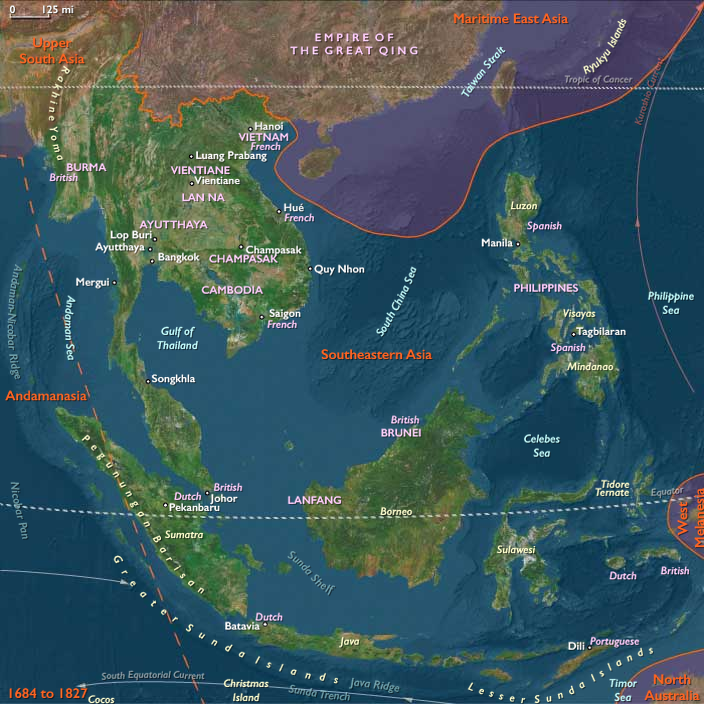
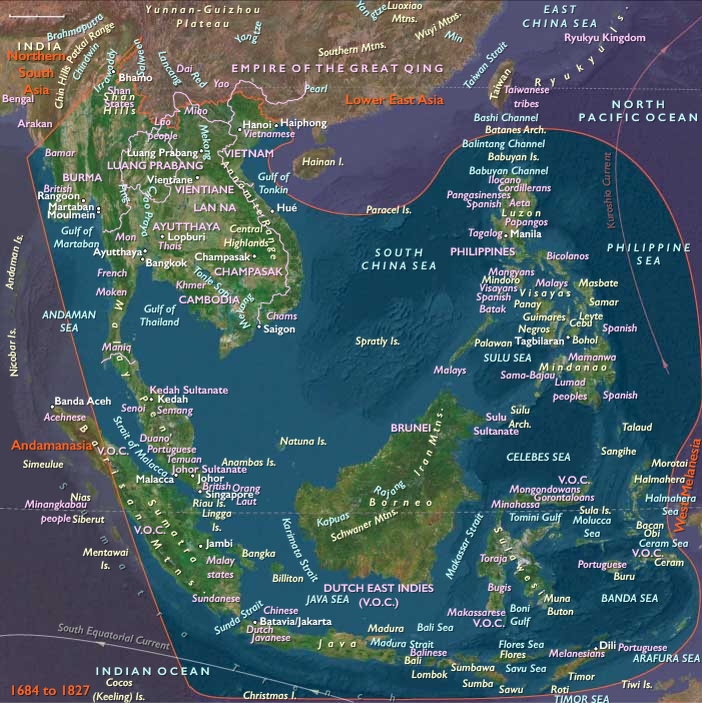
In the early years of Minh Mạng's government, the most serious challenge will come from one of his father's most trusted lieutenants and a national hero in Vietnam, Lê Văn Duyệt, who had led the Nguyễn forces to victory at Qui Nhơn in 1801 against the Tây Sơn Dynasty and had beem made regent in the south by Gia Long with full freedom to rule and deal with foreign powers.
People
Groups
Subjects
Regions
Subregions
Related Events
Filter results
Showing 10 events out of 20417 total
However, all of these attempts had failed and it was to be over twenty years before a way across was found.
In May 1813, Gregory Blaxland, William Lawson and William Charles Wentworth had set out with a plan to find a passage through the impenetrable Blue Mountains.
After twenty-one days of traveling through fifty miles (eighty kilometers) of rugged terrain, the party reached Mount Blaxland.
From here they saw a vast expanse of forest and grass.
This was in fact the land of the Wiradjuri people, one of the largest language groups in Australia.
The Wiradjuri inhabit an area bounded by the Blue Mountains in the east, the western slopes in the south, and the change of open forest to grassy plains in the north and west.
The tribes led by Windradyne live in the eastern parts of this territory, connected to the other groups by a common language as well as cultural and trade links.
After passage through the Blue Mountains had been secured, assistant surveyor George Evans and his party had been instructed to further explore the country.
Evans' reports confirmed of excellent pastures beyond the mountains to which Governor Macquarie ordered a road be built from the Nepean River.
In less than six months the one hundred-mile (one hundred and sixty kilometer) road had been completed.
Soon after, Governor Lachlan Macquarie and a large accompanying party set out to view the country.
The journey took nine days by coach from Parramatta and on arrival Macquarie's welcoming ceremony was observed by seven Wiradjuri.
Three days later Macquarie inaugurated the town of Bathurst, then continued to tour the surrounding country.
In 1820, the population of Bathurst is only one hundred and fourteen due to Macquarie's slow and cautious approach to new settlement.
His experience of the Hawkesbury and Nepean Wars of 1795–1816 may also have made him hesitant to start a new conflict.
It seems that the Wiradjuri are willing to tolerate this slow level of growth and peaceful relations are maintained during this period.
The first cholera pandemic occurs in the Bengal region of India, near Calcutta starting in 1817 through 1824.
The disease disperses from India to Southeast Asia, the Middle East, Europe, and Eastern Africa through trade routes; it will ultimately kill thousands in China and the Philippines.
In March 1820, the disease is identified in Siam; in May 1820, the disease has spread as far as Bangkok and Manila.
Scholars of particular areas have estimated death tolls.
For instance, some estimate that Bangkok might have suffered thirty thousand deaths from the disease.
China imports two hundred and seventy tons of opium in 1820, despite the ban.
The claim of Russian support made by Filiki Etaireia (Greek: Friendly Society) and the romance of its commitment (each member swears “irreconcilable hatred against the tyrants of my country”) have brought thousands into its ranks.
Though some recruits believe that the Russian emperor’s foreign secretary—Greek Count Ioánnis Kapodístrias—secretly directs the society, it is Alexandros Ypsilantis, an officer in the Russian Army and the son of a Phanariote prince, who accepts the leadership in 1820, by which time only a spark is required to set the revolution ablaze.
Mahmud's decision to curb Muhammad Ali ignites a civil war that provides the opportunity for the Filiki Etaireia and its leader Ypsilantis to launch a Greek uprising.
Hans Christian Ørsted, a Danish natural philosopher, discovers electromagnetism—the relationship between electricity and magnetism—during a lecture demonstration given in April 1820, when Ørsted notices a compass needle deflects from magnetic north when an electric current from a battery is switched on and off, confirming a direct relationship between electricity and magnetism.
His initial interpretation is that magnetic effects radiate from all sides of a wire carrying an electric current, as do light and heat.
Three months later he begins more intensive investigations and soon thereafter publishes his findings, showing that an electric current produces a circular magnetic field as it flows through a wire.
This discovery is not due to mere chance, since Ørsted has been looking for a relation between electricity and magnetism for several years.
The special symmetry of the phenomenon is possibly one of the difficulties that detained the discovery.
The British fleet, having succeeded in defeating the Qawasim pirates, razes Ra's al-Khaimah town and in 1820 makes the Persian Gulf sheiks sign the General Treaty of Peace.
The treaties with the British also involve Dubai and Bahrain.
Although Dubai and Bahrain are not pirate centers, they represent entrepôts where pirates can sell captured goods and buy supplies.
The inclusion of these ports brings two other extended families, the Bani Yas of Dubai and the Al Khalifa of Bahrain, into the trucial system.
Four to five thousand British settlers arrive in 1820 to farm the eastern Cape in the first wave of large-scale British settlement.
After the Napoleonic wars, Britain had experienced a serious unemployment problem, so many of the 1820 Settlers are poor and encouraged to settle in an attempt by the Cape government to close, consolidate and defend the eastern frontier against the neighboring Xhosa peoples, and to provide a boost to the English-speaking population.
Of the ninety thousand applicants, about four thousand were approved, so that many 1820 Settlers initially arrive in the Cape in around sixty different parties between April and June 1820.
The 1820 Settlers are granted farms near the village of Bathurst and supply equipment and food against their deposits, but their lack of agricultural experience leads many of them to abandon agriculture and withdraw to Bathurst and other settlements like Grahamstown, East London and Port Elizabeth, where they typically revert to their trades.
At this time, King Shaka rules the territory with highly trained warriors.
Leaders of the Natal settlers request permission from Shaka to stay on the land.
When the king witnesses the settlers' technological advances, permission is granted in return for access to firearm technology.
The revolt of the brigand Ali Pasha Tepelenë, the most infamous of the local Ottoman authorities who have profited from the weakening control of Constantinople over its empire, is the precipitating factor in the Greek War of Independence.
Ali Pasha, born to a powerful clan from Tepelenë, had spent much of his youth as a bandit.
He had risen to become governor of the Ottoman province of Rumelia, which includes Albania, Macedonia, and Thrace, before establishing himself in 1788 in Janina (now Ioánnina), building in northwest Greece a sizable and wealthy personal fiefdom that threatens the sultan's rule in the southern Balkans.
Like the late Kara Mahmud Bushati, his counterpart in northern Albania, Ali Pasha, called the Lion of Janina, wants to create an autonomous state under his rule.
When Ali Pasha forges links with the Greek revolutionaries, Sultan Mahmud II decides to destroy him.
The sultan first discharges the Albanian from his official posts and recalls him to Constantinople.
Ali Pasha refuses and puts up a formidable resistance (which Britain's Lord Byron will soon immortalize in poems and letters).
