
Wuxue Zuyuan, a Chinese Chan monk known …
Years: 1282 - 1282
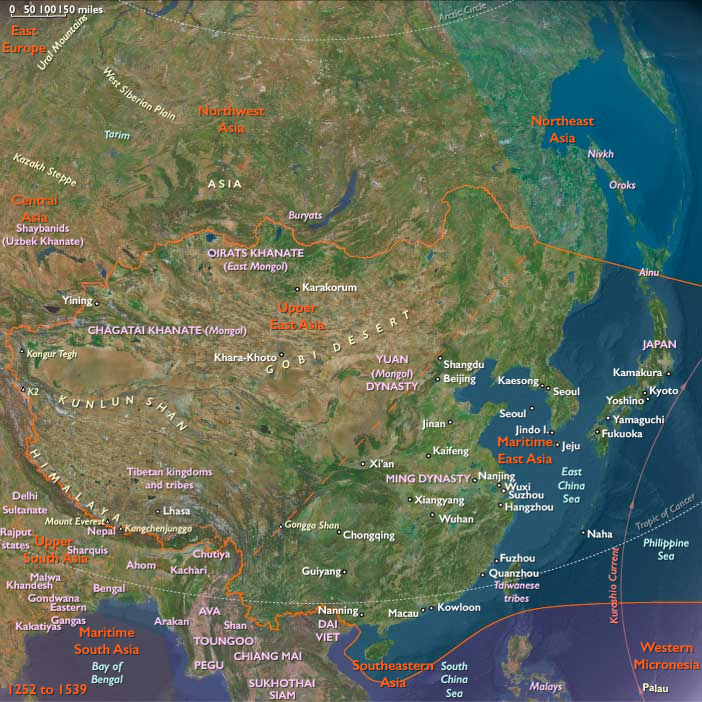
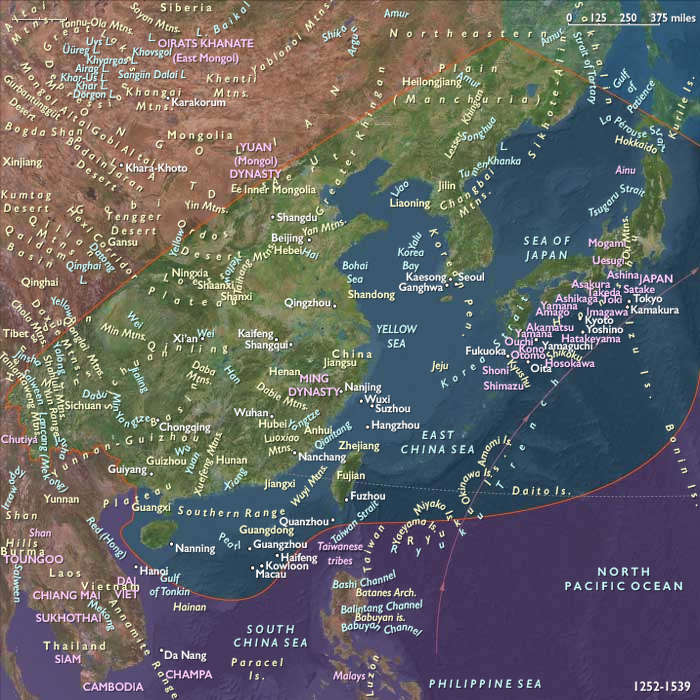
Wuxue Zuyuan, a Chinese Chan monk known in Japan as Mugaku Sogen, accepts an invitation in 1282 to head the newly built Engaku-ji monastery in Kamakura.
Its resident artists will create a significant new impetus in religious painting with the consequent transmission of the Song monastic architectural style and various Chan painting styles later associated with Japanese Zen Buddhism, notably the highly personalized portraits of Zen masters (“chinso”).
Locations
People
Groups
- Japanese people
- Chinese (Han) people
- Buddhists, Zen or Chán
- Japan, Kamakura Period
- Chinese Empire, Yüan, or Mongol, Dynasty
Topics
Subjects
Regions
Subregions
Related Events
Filter results
Showing 10 events out of 45509 total
The Mongols under Kublai Khan had in 1281 ordered the Cham King Indravarman V to come to Bejing with tribute but he refuses.
The Mongols send a fleet down to attack the Cham kingdom and the Cham hide in the hills.
A year later, the Mongols send a large army (an estimated five hundred thousand strong) south to attack the Cham.
This army marches through Vietnam but without Vietnamese permission.
The Vietnamese harass the army in conjunction with the Cham.
With little to show for this display of force, the Mongol army withdraws.
Sogetu of the Jalayir, the governor of Canton, is dispatched to demand the submission of Champa.
Although the king of Champa accepts the status of a Mongol protectorate, his submission is unwilling.
In 1282, Sogetu leads a maritime invasion of Champa with five thousand men, but can only muster one hundred ships because most of the Yuan dynasty's ships had been lost in the invasions of Japan.
However, Sogetu is successful in capturing Vijaya, the Champa capital, later this year.
The aged Indravarman V retreats out of the capital, avoiding Mongol attempts to capture him in the hills.
His son will wage a guerrilla war with the Mongols for the next few years, eventually wearing down the invaders.
Nogai's father Tatar had died when he was serving under Hulegu.
In 1262, during the civil war between Berke and Hulegu Khan, Nogai's army surprised the invading forces of Hulegu at the Terek River.
Many thousands were drowned, and the survivors fled back into Azerbaijan.
In 1265, Nogai led his army across the Danube, sending the imperial forces fleeing before him, and devastated the cities of Thrace.
In 1266, the Emperor Michael VIII Palaeologus, anxious to make an alliance, had given his daughter Euphrosyne Palaeologina to Nogai as a wife.
That same year, Nogai lost an eye fighting his relative, Abaqa Khan, in Tiflis, but he lived on good terms with Abaq and his successor Arghun after the death of Berke.
Nogai rules the Ukrainians of Galicia-Volhynia, the Ossetians and part of the Vlachs directly.
He had attacked Lithuania with the northern Russian princes in 1275.
Nogai sends four thousand Mongol soldiers to Constantinople in 1282, to help his father in law Emperor Michael suppress the rebels headed by John I Doukas of Thessaly, but Michael dies and Andronikos II uses the allied troops to fight against Serbia.
Rudolph installs his sons Albert and Rudolf II as Austrian dukes at the 1282 Diet of Augsburg; their Habsburg descendants will hold the ducal dignity until 1918.
The Habsburgs had taken up residence in Vienna following Ottokar's rebellion and battle death in 1278.
Rudolf gives most of the new territory wrested from Bohemian control-the duchies of Austria, Styria, and Carinthia, and the March of Carniola—to his sons Albert and Rudolph in 1282, thus raising the Habsburg family to the rank of a major German dynasty.
He cements his conquest through strategic marriage contracts for his children.
Rudolf grants his son Albrecht (Albert) the duchies of Austria and …
…Styria, making these possessions hereditary fiefs that will constitute the territorial nucleus of the future Habsburg power.
Michael VIII has spent the years since 1261 fighting off various western plots to restore the Latin emperors, in which the Angevin king Charles I of Naples and Sicily is always his principal opponent.
By negotiating a reunion of the Eastern and Western churches, Michael had induced Pope Gregory X to restrain Charles in 1276, but the union has been broken again.
Transferring the battle to Charles' own country by shrewd diplomacy, Michael finances a successful revolt against Charles, the Sicilian Vespers, which breaks out in 1282.
The Sicilian Vespers thus saves Constantinople from a second occupation by the Latins.
Although Michael's network of diplomacy covers the Mongols of Iran and the Golden Horde in Russia, as well as the Mamluks of Egypt, diplomacy is ineffective against Muslim Ghazis (warriors inspired by the ideal of holy war); by the time the threat from Italy is removed in 1282, it is almost too late to save Greek Anatolia.
Thus, at Michael's death on December 11, 1282, he leaves to his twenty-two-year-old son Andronikos II an empire that is a barely intact.
Excommunicated shortly before his death by Pope Martin for lack of sincerity in the cause of union between the Greek and Latin churches, Michael had saved his empire from its most persistent enemy, but died condemned by his church and people as a heretic and a traitor.
Immediately after his death, the Greek Church declares the union with Rome invalid and a fraud.
Stefan Milutin, the youngest son of King Stefan Uroš I and his wife, Helen of Anjou, unexpectedly becomes king of Serbia at around the age of twenty-nine after the abdication of his brother Stefan Dragutin, who had broken his leg while hunting and become ill.
Immediately upon his accession to the throne, he attacks imperial lands in Macedonia, conquering the northern parts of Macedonia including the city of Skopje, which in 1282 becomes his capital.
Emperor Michael VIII Palaiologos begins preparations for war but dies before their completion.
Florentine sculptor and architect Arnolfo di Cambio creates the tomb of Cardinal Guillaume de Braye following the latter’s death on 1282 in San Domenico at Orvieto.
The massive structure, with its clarity of line, testifies to Arnolfo’s familiarity with both classical and French Gothic art.
It includes an enthroned Madonna (a Maestà) for which he took as a model an ancient Roman statue of the goddess Abundantia; the Madonna's tiara and jewels reproduce antique models.
As proved by restorations, the statues of the Madonna is in fact a second-century BCE Roman sculpture.
One of the first churches of the Dominican Order, the edifice has a nave and two aisles; what remains today are only the apse and the transept, after most of the church was demolished in 1932 to house the Female Academy of Gymnastics.
Charles I of Naples and Sicily, whose expansionist policies have taken him on extensive campaigns in the Balkans against the resuscitated Greek empire, is the target of a conspiracy in which important foreign leaders, including Emperor Michael VIII Palaiologos and Peter III of Aragon, move to prevent Charles from invading the empire.
Many Ghibelline officials had fled the Kingdom of Sicily to the court of Peter III of Aragon, who had married Constance, the daughter and heir of Manfred.
Manfred's former chancellor, John of Procida, had arranged contact between Michael, Peter and the refugees at his court, and conspirators on the island of Sicily itself.
Peter had begun to assemble a fleet at Barcelona, ostensibly for another Crusade to Tunis.
In fact, the master-plan of John of Procida is to place Peter on the throne of Sicily, his Hohenstaufen inheritance.
Charles has introduced feudalism to the Italian south at a time when it is weakening elsewhere.
His oppressive regime is highly unpopular, particularly in Sicily.
A spontaneous outbreak against Angevin rule, possibly fanned by agents provocateurs in the pay of Aragon and Constantinople, begins in Palermo at the time of vespers (evening worship) on Easter Monday, 1282, when some Sicilians attending a church service assault and kill several French soldiers.
who had insulted them The revolt, spreading across the island, results in the massacre, during the night of March 30-31, of about two thousand French inhabitants, almost the entire French population of Sicily.
Years: 1282 - 1282
Locations
People
Groups
- Japanese people
- Chinese (Han) people
- Buddhists, Zen or Chán
- Japan, Kamakura Period
- Chinese Empire, Yüan, or Mongol, Dynasty
