A center of Buddhist studies is established …
Years: 440 - 440
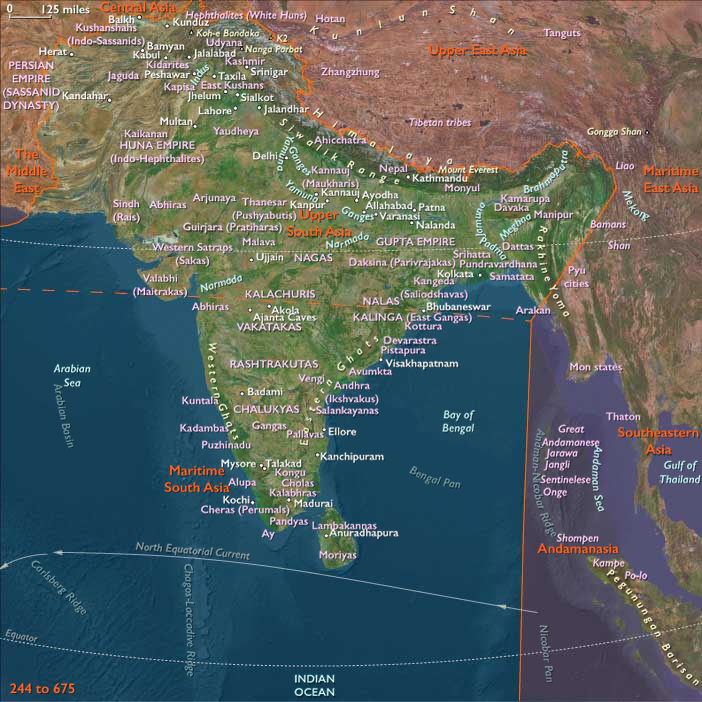
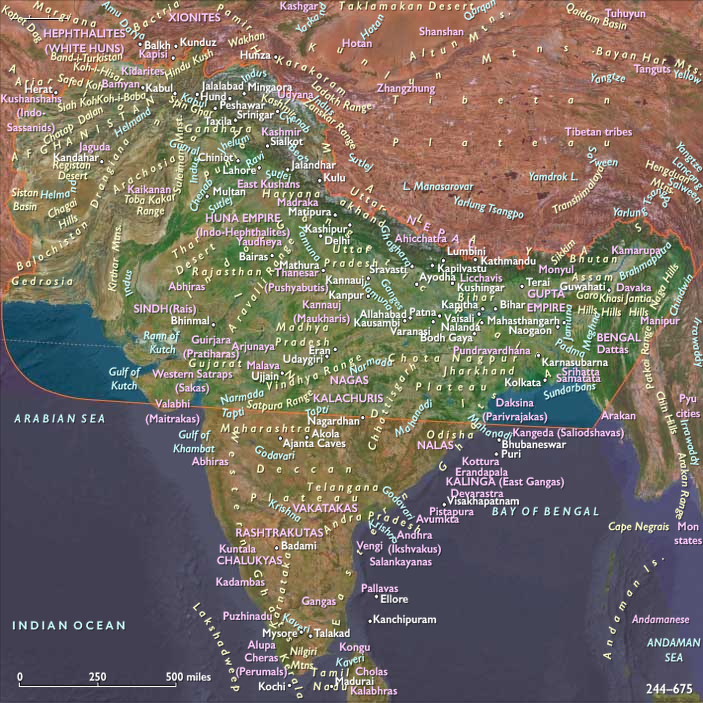
A center of Buddhist studies is established at Nalanda in Bihar on the plains of the Ganges River (India).
Locations
Groups
Topics
Subjects
Regions
Subregions
Related Events
Filter results
Showing 10 events out of 58820 total
The Huns under Attila, reappearing in force along the frontier of the Western Roman Empire, attack merchants on the north bank of the Danube and cities in Illyricum, including (according to Priscus) Viminacium, a city of Moesia.
The Romans, failing in their attempt to peacefully reverse Yazdegird’s persecution of Christians in the Persian empire, wage a brief and successful war against Persia in 440; Theodosius’ generals repelling yet another Persian invasion.
Theodosius II sends his commander, Anatolius, to conclude his terms and promise not to build any new fortifications along the border territories.
Socrates of Constantinople, also known as Socrates Scholasticus, designs his church history as a continuation of Eusebius of Caesarea's Historia ecclesiastica, arranging the work in seven books, each covering the life of one of the Roman emperors from 305 to 439.
Yazdegerd's focus had shifted to Armenia, Caucasian Albania and the Roman Empire in his offensive against the Huns.
Romans had been constructing fortifications in the nearby Persian territory of Carrhae, in anticipation of subsequent expeditions.
Roman Emperor Theodosius II asks for peace and sends his commander, Anatolius, personally to Yazdegerd's camp.
In the ensuing negotiations in 440, both empires promise not to build any new fortifications in their border territories.
The church of the White Monastery (Deir-el-Abiad) near Sohag, in Upper Egypt, is established in 440.
An archetype of Coptic architecture, the basilica (still standing), features a longitudinal nave and flanking side aisles, with an elaborate triconch apse built to a trefoil, or clover-shaped plan.
Its massive outer wall imitates the exterior of ancient Egyptian temples.
The name of Pope Sixtus III is often connected with a great building boom in Rome: Santa Sabina on the Aventine Hill was dedicated during his pontificate and he built Santa Maria Maggiore, whose dedication to Mary the Mother of God reflected his acceptance of the Ecumenical council of Ephesus, which closed in 431.
At that council, the debate over Christ's human and divine natures had turned on whether Mary could legitimately be called the "Mother of God" or only "Mother of Christ".
The council gave her the Greek title Theotokos (literally "God-bearer", or "Mother of God"), and the dedication of the large church in Rome is a response to that.
The Parting of Lot and Abraham, a Late Antique mosaic, is one of a series of scenes, probably dating to the 430s, decorating the nave wall of Santa Maria Maggiore, one of the most prominent basilican churches in Rome.
The mosaic shows the story in the biblical Book of Genesis of the parting of Abraham from his nephew, Lot, as they choose opposing paths.
Abraham chooses the road to Canaan, as God intends him to, and Lot chooses to take his followers to Sodom.
The work is a tessera mosaic, tessera describing the material making up the surface of the work.
Most tessera works during this time would be made up of small pieces of limestone or marble, cut to shape, and arranged by the artist.
The artist uses several conventions of the time.
The grouping of the characters is varied, meant to create the illusion of space.
This "shorthand" way of depicting a crowd is sometimes called a "head cluster".
There is a hieratic abandonment of consistent and realistic proportions and scale, allowing the artist to put emphasis on the characters of his choosing using attributes like size.
The main characters we are intended to focus on are made extremely clear through this method, and the picture itself becomes less illustrative and more symbolic.
Eventually this style comes to a refined maturity during the Middle Ages.
The move towards completely two-dimensional representative images has already started, and although this mosaic implements the use of lights and darks, with shadows corresponding to the figures, there is a good indication as to what direction religious art is heading.
Santa Maria Maggiore is one of only four Catholic churches that today hold the title of major basilica.
As well as this church on the summit of the Esquiline Hill, Sixtus III is said to have commissioned extensive building projects throughout the city, which are continued, after his death on August 18, 440, by his successor Pope Leo I. Leo I begins to formulate orthodoxy and condemns Eutychianism, an extreme form of monophysitism, which holds that the human nature of Christ is absorbed by his divine nature.
In the winter, Leo I sends a letter to Valentinian III, stating "by the Holy Spirit's inspiration the emperor needs no human instruction and is incapable of doctrinal error".

A Vandal fleet and their allies (Alans, Goths and Moors) set out in the winter of 439-440 from Carthage for Sicily, the principal supplier of oil and grain to Italy after the loss of North Africa.
They loot all the coastal towns and besiege Palermo.
Heavily laden ships return to the court of king Genseric.
Aetius, returning as triumphator back to Rome after several years' fighting the Burgundians and Visigoths in Gaul, is honored by a statue erected by the Senate and by order of emperor Valentinian III.
Rechila remains in near-constant conflict with the Romans throughout his reign.
In 440 CE, while returning from his third embassy to the Suevi, the Roman legate Censorius is captured by Rechila near Mértola (Myrtilis). Rather than releasing him or negotiating a settlement, Rechila imprisons Censorius for the remainder of his reign, further escalating hostilities between the Suevi and the Western Roman Empire.
The Huns, led by Attila, attack Constanţa (in modern Romania), one of the few remaining Roman forts on the northern bank of the Danube and designated as a secure trading post.
On a crowded market day, the Huns take the town by surprise and slaughter the garrison.
The historians of the Eastern Roman Empire give us a considerable amount of information on Chrysaphius, whose real name was Taiouma (Theophanes 151) or Tumna (Cedrenus I 601) or Tzoumas (Patria II 182; George Codinus 47) or even Ztommas (Malalas 363-6).
Chrysaphius exercises a considerable influence on Theodosius II at the end of his reign.
According to Malalas, Theodosius II loved Chrysaphius for his beauty (Malalas id and 368).
He seems to have risen from among the ranks: according to Malalas, he was a mere cubicularius (servant of the imperial bedchamber); according to the Chronicon Paschale, he was a spatharios (p. 390).
In 441, the city prefect in Constantinople is a pagan poet from Panopolis in Egypt named Cyrus, who is exceedingly popular in the city.
Thus he incurs the envy of Chrysaphius, who engineers his downfall.
Cyrus saves himself by converting to Christianity, but the malice of Chrysaphius is not so easily frustrated, and the eunuch arranges for him to be appointed bishop of Cotyaeum in Phyrgia, where the population has lynched the previous four incumbents.
In the event, Cyrus survives and will return to Constantinople in 451 after the death of Chrysaphius.