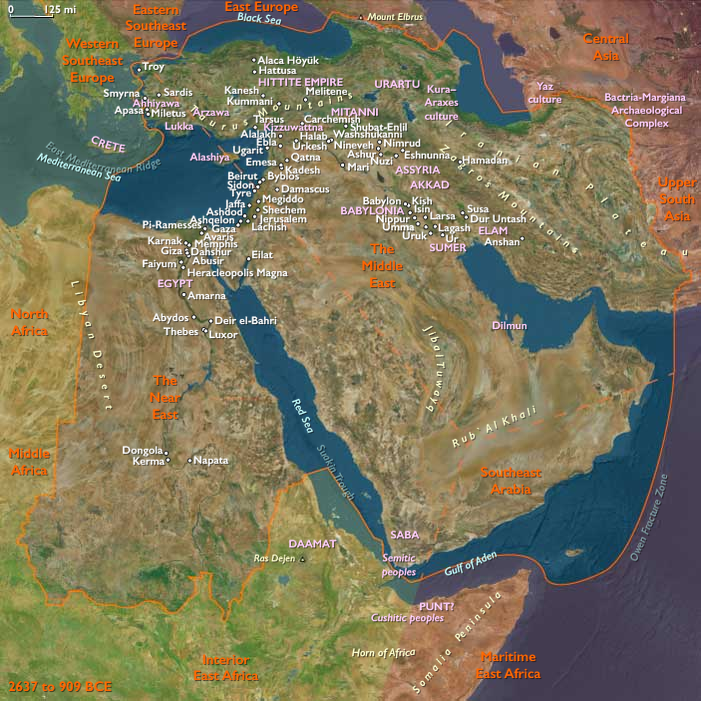
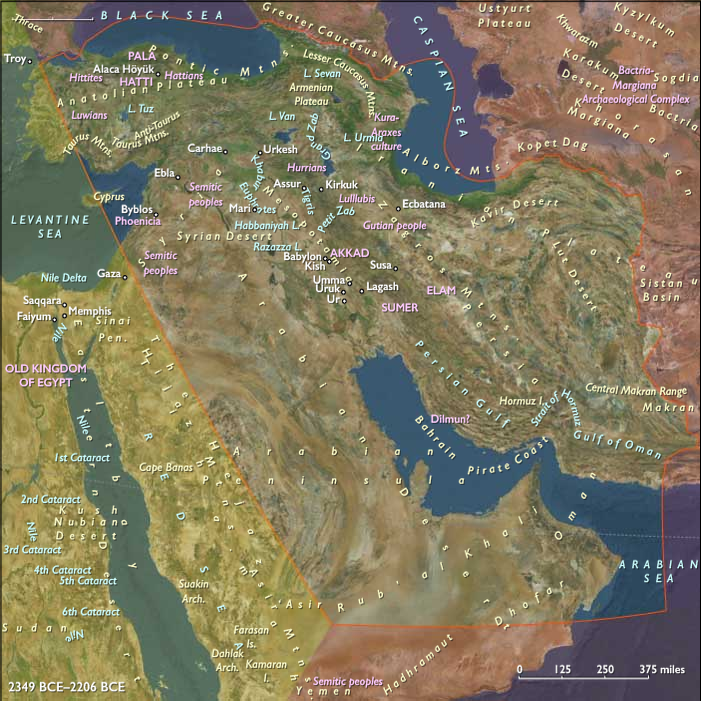
A map of a river valley between …
Years: 2349BCE - 2206BCE
A map of a river valley between two hills is shown on a 7.6 centimeter by 6.8 centimeter clay tablet found in 1930 at Ga-Sur, near contemporary Kirkuk.
Most scholars date the tablet to the twenty-fifth to twenty-fourth century BCE.
Cuneiform inscriptions label the features on the map, including a plot of land described as three hundred and fifty-four iku (twelve hectares) that was owned by a person called Azala.
Locations
Groups
Topics
Subjects
Regions
Subregions
Related Events
Filter results
Showing 10 events out of 31 total
Rome has gradually incorporated Greek territory into its empire over a period of about two hundred and fifty years.
The Greek and Roman worlds each will change significantly because of the resultant interaction.
The Romans bring order to the region, and their inventive genius will produce lasting monuments.
Among the fragile Hellenistic kingdoms, Macedonia is now a mere province of Rome, Ptolemaic Egypt is a Roman client state, and the formerly mighty Seleucid empire is now confined to the provinces of Syria and eastern Cilicia, and even those are under tenuous control in 64 BCE, when the Romans finally conquer the kingdom.
The Anatolian provinces enjoy prosperity and security after the accession of the Roman emperor Augustus (r. 27 BCE -CE 14), and for generations thereafter.
All of Anatolia except Armenia, which is a Roman client-state, is integrated into the imperial system by CE 43.
The cities are administered by local councils and send delegates to provincial assemblies that advise the Roman governors.
Their inhabitants are citizens of a cosmopolitan world state, subject to a common legal system and sharing a common Roman identity.
Roman in allegiance and Greek in culture, the region nonetheless retains its ethnic complexity.
Verus’ journey continues by ship through the Aegean and the southern coasts of Asia Minor, lingering in the famed pleasure resorts of Pamphylia and Cilicia, before arriving in Antioch.
It is not known how long Verus' journey east took; he might not have arrived in Antioch until after 162.
Statius Priscus, meanwhile, must have already arrived in Cappadocia; he will earn fame in 163 for successful generalship.
Lucius spends most of the campaign in Antioch, though he wintered at Laodicea and summers at Daphne, a resort just outside Antioch.
He takes up a mistress named Panthea, from Smyrna.
The biographer calls her a "lowborn girlfriend", but she is probably closer to Lucian's "woman of perfect beauty", more beautiful than any of Phidias and Praxiteles' statues.
Polite, caring, humble, she sings to the lyre perfectly and speaks clear Ionic Greek, spiced with Attic wit.
Panthea reads Lucian's first draft, and criticizes him for flattery.
He had compared her to a goddess, which frightens her—she does not want to become the next Cassiopeia.
She has power, too: she makes Lucius shave his beard for her.
Critics declaim Lucius' luxurious lifestyle.
He has taken to gambling and enjoys the company of actors.
He makes a special request for dispatches from Rome, to keep him updated on how his chariot teams are doing.
He brings a golden statue of the Greens' horse Volucer around with him, as a token of his team spirit.
Fronto defends his pupil against some of these claims: the Roman people need Lucius' bread and circuses to keep them in check.
This, at least, is how the biographer has it.
The whole section of the vita dealing with Lucius' debaucheries (HA Verus 4.4–6.6) is an insertion into a narrative otherwise entirely cribbed from an earlier source.
Some few passages seem genuine; others take and elaborate something from the original.
The rest is by the biographer himself, relying on nothing better than his own imagination.
Lucius faces a heavy task.
Fronto describes the scene in terms recalling Corbulo's arrival one hundred years before.
The Syrian soldiers, having turned soft during the east's long peace, spend more time at the city's open-air bars than in their quarters.
Under Lucius, training is stepped up.
Pontius Laelianus orders that their saddles be stripped of their padding.
Gambling and drinking are sternly policed.
Fronto writes that Lucius was on foot at the head of his army as often as on horseback.
He personally inspects soldiers in the field and at camp, including the sick bay.
Lucius sends Fronto few messages at the beginning of the war, but does send Fronto a letter apologizing for his silence.
He will not detail plans that could change within a day, he writes.
Moreover, there is little thus far to show for his work.
Lucius does not want Fronto to suffer the anxieties that have kept him up day and night.
One reason for Lucius' reticence may have been the collapse of Parthian negotiations after the Roman conquest of Armenia.
Lucius' presentation of terms is seen as cowardice.
The Parthians are not in the mood for peace.
Lucius needs to make extensive imports into Antioch, so he opens a sailing route up the Orontes.
Because the river breaks across a cliff before reaching the city, Lucius orders that a new canal be dug.
After the project is completed, the Orontes' old riverbed dries up, exposing massive bones—the bones of a giant.
Pausanias says they were from a beast "more than eleven cubits" tall; Philostratus says the it was "thirty cubits" tall.
The oracle at Claros declares that they are the bones of the river's spirit.

The Roman general Avidius Cassius, governor of Syria, who earlier had served under the late Emperor Lucius Verus, has by 175 virtually become a prefect of all of the eastern provinces, including control of the important province of Egypt.
In this year, Avidius Cassius takes the occasion of a rumor of Marcus Aurelius' death to proclaim himself emperor.
Marcus, very much alive, makes peace in the north with those tribes not already subjugated, and prepares to march against Avidius, who, having been accepted as Emperor by Syria, Palestine and Egypt, Cassius carries on his rebellion even after it has become obvious that Marcus is still alive.
Of the eastern provinces, only Cappadocia and Bithynia do not side with the rebels.
Cassius' fortunes decline quickly and the rebel general dies at the hands of one his own centurions after only one hundred days of power and before the campaign against him can begin.
The emperor, who apparently arrives in Antioch after the fact, uses the opportunity to make a tour of pacification and inspection in the East, first visiting Antioch, then crossing to Egypt.
Severus’s rearguard in the northwest is now protected by his offer of the rank of Caesar to Clodius Albinus, the powerful governor of Britannia who had probably supported Didius Julianus against him.
The imperial contender advances with his legions east into the empire against Pescennius Niger, the Roman governor of Syria who had been acclaimed Emperor by his troops, like Severus, following the death of Pertinax.
Severus wins victories over his Syrian rival Niger at the battles of Cyzicus and …
…Nicaea in 193, whereupon Niger's army successfully withdraws to the Taurus mountains, where it fiercely defends the Cilician pass.
At this time the commander of the Severan troops, Tiberius Claudius Candidus, is replaced by Publius Cornelius Anullinus, perhaps due to the failure of the former to prevent the withdrawal of the rival army.
Anullinus enters Syria eventually and the final battle takes place in May 194, near Issus, the place where Alexander the Great defeated the Persian King Darius III in 332 BCE.
Severus takes advantage of the control he had on the lives of the children of the provincial governors, who are left at Rome, as well as the rivalries of the cities in the region, thus encouraging governors to change sides, one legion to desert to him and some cities to revolt.
Severan troops attack first while Niger's forces are hurling missiles against them.
At the same time, the Severan cavalry attacks from the rear.
The fight is hard but in the end Severus wins decisively and Niger flees back to Antioch.
A sudden thunderstorm plays some role in lowering the morale of Niger's troops, who are directly facing it, because they attribute it to divine intervention.
A triumphal arch is set on site, commemorating the victory of Severus.
This concludes hostilities on the field between the two rivals for control of the East (Niger is captured and killed, a few days later).
Septimius Severus, having become Roman emperor in 197, lands at the port of Aegeae in Cilicia.
Traveling to Syria by land, …
…Severus immediately gathers his army and crosses the Euphrates.
Abgar IX, King of Osroene but essentially only the ruler of Edessa since the annexation of his kingdom as a Roman province, hands over his children as hostages and assists Severus' expedition by providing archers.
Tiridates II, King of Armenia (ruled from about 197 to 238), also sends hostages, money and gifts at this tim,
Palmyra, ('city of palm trees'), a long-prominent trading city built on an oasis along one of the main routes of east-west trade one hundred and forty miles (two hundred and thirty kilometers) northeast of Damascus, had come under Roman control by the time of the emperor Tiberius.
However, with the Sassanians having supplanted the Parthians in Persia and southern Mesopotamia in 227, the road to the Persian Gulf had soon been closed to Palmyrene trade.
Still relatively autonomous, Palmyra has grown increasingly wealthy and influential due to its tariff on the caravans passing through the city.
In return, the local rulers have policed caravan routes and the border area.
Instability around the Roman-controlled Mediterranean, coupled with the interruption of caravan trade with the East, had led the Romans to set up the personal rule here of the leading Palmyrene family of Septimius Odainath, or Odaenathus, a Roman citizen appointed governor of Syria Phoenice by Valerian.
The year is not known, but already in an inscription dated 258 he is styled "the illustrious consul our lord".
The defeat and captivity of Valerian in 260 has left the eastern provinces largely at the mercy of the Persians; the prospect of Persian supremacy is one that neither Palmyra nor its ruler have any reason to desire.
At first, it seems, Odaenathus had attempted to propitiate the Persian monarch Shapur.
However, when his gifts had been contemptuously rejected (Petr. Patricius, 10) he had decided to throw in his lot with the cause of Rome to prevent his city from falling under Sassanian control.
He thus abandons the neutrality that has made Palmyra's fortune for an active military policy that, while it will add to Odaenathus's fame, in a short time will bring his native city to its ruin.
Before Shapur’s army, returning home in 260 rich in plunder from its sack of Antioch, can cross the Euphrates, Odaenathus deals it a severe defeat, thereby curtailing further Persian aggression in Syria and Asia Minor.