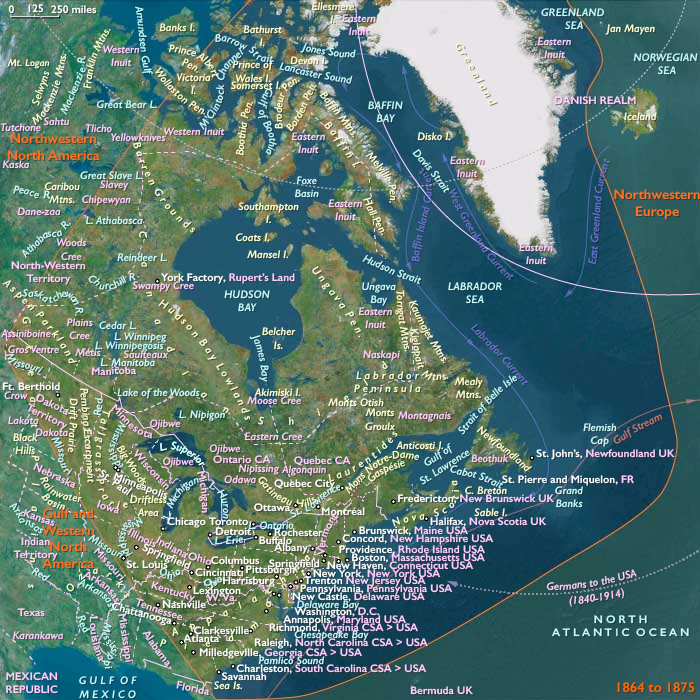
Philip and Henry Armour form Armour and…
May 1867 CE
Philip and Henry Armour form Armour and Company in 1867, which will soon become the world's largest food processing and chemical manufacturing enterprise, headquartered in Chicago, Illinois.
Armour & Co. is the first company to produce canned meat and also one of the first to employ an "assembly-line" technique in its factories.
Philip Danforth Armour was one of eight children born in Stockbridge, New York, to Danforth Armour and Juliana Ann Brooks, and had grown up on his family's farm.
Armour is descended from colonial settlers of Scottish and English origin, with his surname originating in Scotland.
He had been educated at Cazenovia Academy in New York until the school expelled him for taking a ride in a buggy with a girl.
Among his first jobs was that of Driver on upstate New York's Chenango Canal which ran through Madison County at that time and would have been a busy thoroughfare.
At the age of nineteen, Armour had left New York with about thirty other people for California, joining the great California gold rush.
Before the journey, Armour “had received several hundred dollars from his parents,” making him, for the most part, “the financier of the party,” according to biographer Edward N. Wentworth.
(Wentworth, Edward N. (1920). Biographical Catalog of the Portrait Gallery of the Saddle and Sirloin Club. Chicago, IL: Union Stock Yards. p. 178.)
In California, Armour had eventually started his own business, employing out-of-work miners to construct sluices, which controlled the waters that flowed through the mined rivers.
In only a few years, Armour had turned his business into a profitable enterprise, earning himself about eight thousand dollars by the time he had turned twenty-four.
With his sizable fortune in hand, Armour had then moved to Milwaukee, Wisconsin, starting a wholesale grocery business.
In Milwaukee, Armour had formed business partnerships with Frederick Miles in the grain business in 1859, working with Miles for three years before he partnered with John Plankinton in the meatpacking industry, creating the company Plankinton, Armour & Company.
It was also during this period that Armour had married Malvina Belle Ogden in 1862.
Although the company was a relatively modest endeavor at its start, Armour had demonstrated his uncanny ability as a young businessman by taking advantage of changing meat prices during and after the Civil War.
According to Deborah S. Ing, author of Philip Armour’s biography in the American National Biography Online, “the most important business coup of Armour's early career occurred near the end of the Civil War when he predicted heavy Confederate losses and thus the dropping of pork prices…he made contracts with buyers at $40 per barrel before prices plummeted to $18 when the war ended in a Union victory. This deal netted him a profit of $22 per barrel or an alleged total of $1 million to $2 million.” (Ing, Deborah. "Philip Danforth Armour". American National Biography Online.)
Armour’s savvy decision had catapulted Plankinton, Armour & Co. into a new stratosphere of American business, allowing the corporation to expand into other cities such as Kansas City, Missouri.
Later on, with his brother, Herman, he had again entered the grain business and built several meat packing plants in the Menominee River Valley.
Groups
Commodities
Regions

Northern North America
View →Subregions