
Boston University traces its roots to the…
April 1839 CE
Groups
Subjects
Regions
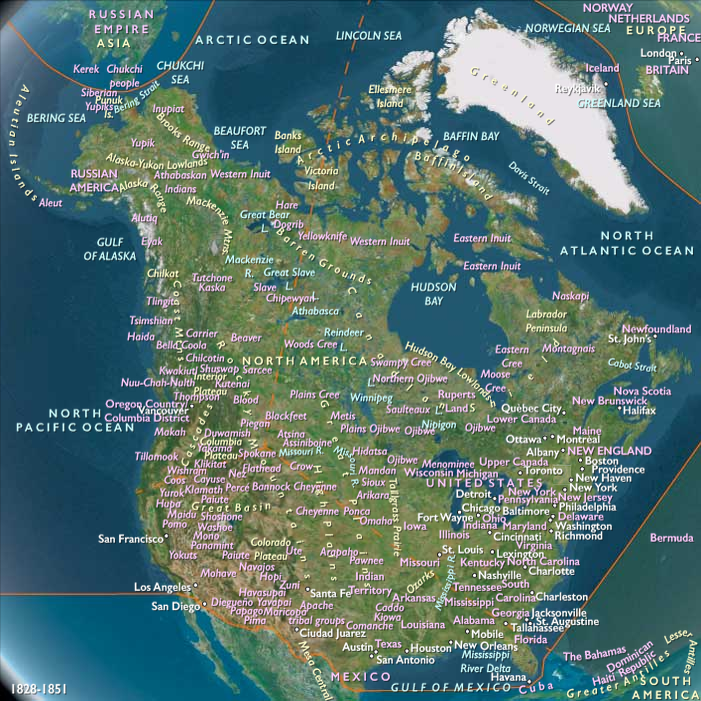
Northern North America
View →Subregions
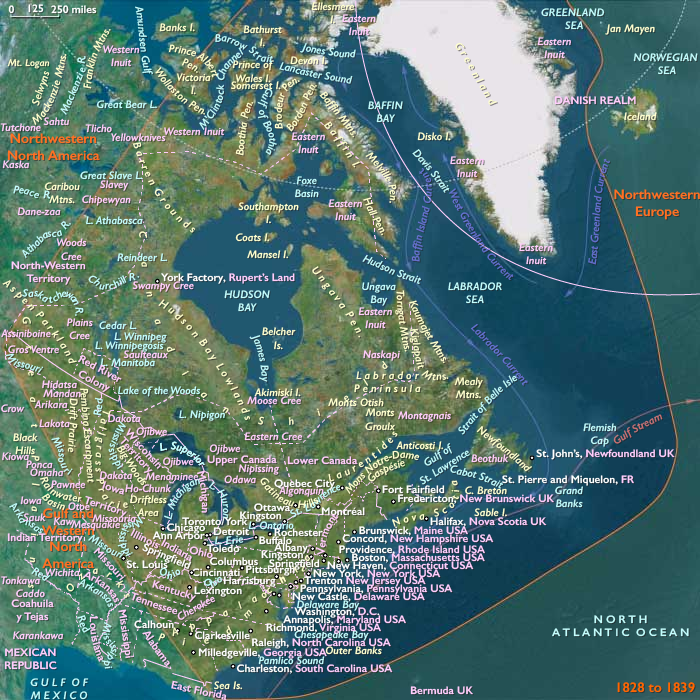
Northeastern North America
View →Related Events
No active filters.
Showing 10 events out of 18167 total
The New Zealand Company (the first to bear the name) had formed in London in 1825 and sent out settlers, led by Captain James Herd, to the Hokianga in the far north of New Zealand.
The company's investors hoped for large profits, convinced there were fortunes to be made from New Zealand flax, kauri timber, whaling and sealing, but little of permanence had come of the venture.
In 1837, Edward Gibbon Wakefield had persuaded a group of notable men to join him in the New Zealand Association to promote the settlement of New Zealand.
As early as 1829, while in prison for abducting a fifteen-year-old heiress, he had published a pamphlet promoting the colonizing of Australasia.
Wakefield's plan entailed the company buying land from the indigenous residents very cheaply and then selling it to speculators and "gentleman settlers" for a much higher sum.
The emigrants would provide the labor to break in the gentlemens' lands and cater to their employers' everyday needs.
They would eventually be able to buy their own land, but low rates of pay would ensure they first labored for many years.
However, they had encountered strong opposition in London from the Colonial Minister and from the Church Missionary Society, and the Association had lapsed.
The following year, however, several of the intending colonists had formed a joint stock company.
Former members of the New Zealand Association join them and obtain a charter for the New Zealand Land Colonisation Company in 1839.
Once again, Wakefield provides the driving impetus.
The British, concerned over Wakefield’s dispatch of a survey party to purchase Maori lands and suspicious of increasing French activity on South Island, appoint naval captain William Hobson lieutenant governor of New Zealand, still a part of the New South Wales colony.
Events start to push the politicians towards a declaration of British sovereignty over New Zealand.
The officers of the New Zealand Company know that such a declaration, if that were to happen, would involve a freeze on all land sales pending the establishment of effective British control.
They have other plans, which involve treating New Zealand as a foreign country and buying the land directly from the Maori, knowing they can get a better deal that way.
George Grey returns to Western Australia in 1839 and is again wrecked with his party at Kalbarri; they are the first Europeans to see the Gascoyne River but must then walk to ...
...Perth, surviving the journey through the efforts of Maigo, a Whadjuk Noongar, who organizes food and what water can be found (they survive by drinking liquid mud).
At about this time, Grey becomes one of the few Europeans to learn the Noongar language of southwest Western Australia.
In February 1825, Minh Mạng had banned missionaries from entering Vietnam.
French vessels entering Vietnamese harbors were ordered to be searched with extra care.
Between 1833 and 1838, seven missionaries had been sentenced to death, among them Pierre Borie, Joseph Marchand, and Jean-Charles Cornay.
Minh Mạng had first attempted to stifle the spread of Christianity by attempting to isolate Catholic priests and missionaries from the populace.
Asserted that he had no French interpreters after Jean-Baptiste Chaigneau's departure in 1826, he had summoned the French clergy to Hue and appointed them as mandarins of high rank to woo them from their proselytizing.
This had worked until a priest, Father Regereau, entered the country and began missionary work.
Following the edict which forbade further entry of missionaries into Vietnam, arrests of clerics began.
After strong lobbying by Duyệt, the governor of Cochin China, and a close confidant of Gia Long and Pigneau de Behaine, Minh Mạng agreed to release the priests on the condition that they congregate at Đà Nẵng and return to France.
The seat of the Governor-General of Western Siberia is moved to Omsk in the 1820s or 1830s.
Bowing to the city's authority, many Siberian towns, including Omsk, ...
The accusation of ritual murder by the Jews is again raised in the 1830s in Ukraine.
Facing severe economic hardship and social upheaval, tens of thousands of Jews have migrated to the cities, especially Odessa on the Russian Black Sea coast.
In their new urban environments, the restless and highly literate Jews clamor for the liberalization of tsarist rule.
...Tomsk, and ...
...Tyumen, have their original arms display the Tobolsk insignia.
Omsk honors the legacy to this day.
Carl Gustaf Mosander discovers the element lanthanum as the oxide (lanthana) in 1839, distinguishing it from cerium oxide, or ceria, after partially decomposing a sample of cerium nitrate by heating and treating the resulting salt with dilute nitric acid.
He names the element for Greek lanthanein, to be concealed, indicating that it is difficult to isolate.
Mosander, who had worked as a teacher of chemistry at the Karolinska Institute and as an assistant in the mineralogical collection of the Swedish Museum of Natural History, had been a chemistry student of Berzelius during his medical studies, and in 1836 had succeeded him as professor of chemistry and pharmacy in the Institute.
The opposition to Jewish liberalization, led by the Orthodox rabbis called Mitnaggedim (”opponents”), had remained firm until the 1830s, when the spread of Haskala, the Jewish Enlightenment, in Eastern Europe had presented both Hasidim and Mitnaggedim with a common enemy.